Related Posts
The List of Styles in Tattooing
Tattoo “styles” are dialects of a craft — shared visual rules, shared methods, shared histories that let artists and clients speak a common language. But there is no single, universally accepted taxonomy. Some labels describe an aesthetic (American Traditional, Trash Polka). Some describe a palette (Black & Grey). Some are fundamentally about technique (Fine line, Dotwork, Handpoke). And some are culture-bound practices where meaning, permission, and protocol are inseparable from the design (Sāmoan pe’a/malu, Māori tā moko, Sak Yant). Classification debates don’t resolve — especially when a trend-made label like cyber-sigilism starts behaving like a “style” while borrowing from much older traditions.
Taxonomy and what’s disputed
A useful mental model: treat “style” as three overlapping layers.
- Aesthetic families are the most intuitive. You can recognise them from across a room — American Traditional, Neo-traditional, New School, Trash Polka, etc.
- Technique labels describe how the tattoo is made rather than what it depicts. “Fine line” is defined by needle gauge and liner choice; it can appear inside many aesthetics — minimalism, microrealism, delicate script, even Chicano-inspired work. Dotwork and Handpoke behave the same way: dotwork is a mark-making method; handpoke is a non-electric application.
- Culture-bound traditions — Sāmoan tatau, Māori tā moko, Sak Yant, batok — are the most ethically sensitive to style shopping. They are not decorations. They carry identity, obligation, ritual authority, and community meaning.
Disputes flare when an internet label gets popular, and people try to retrofit history onto it. Cyber-sigilism is the current case: widely framed as coined by Aingelblood, celebrated as a Gen Z visual language, and criticised as “another tribal wave”, which raises questions of appropriation even when its creators argue the work is original rather than borrowed.
Tools and the machine that changed everything
Style Encyclopedia
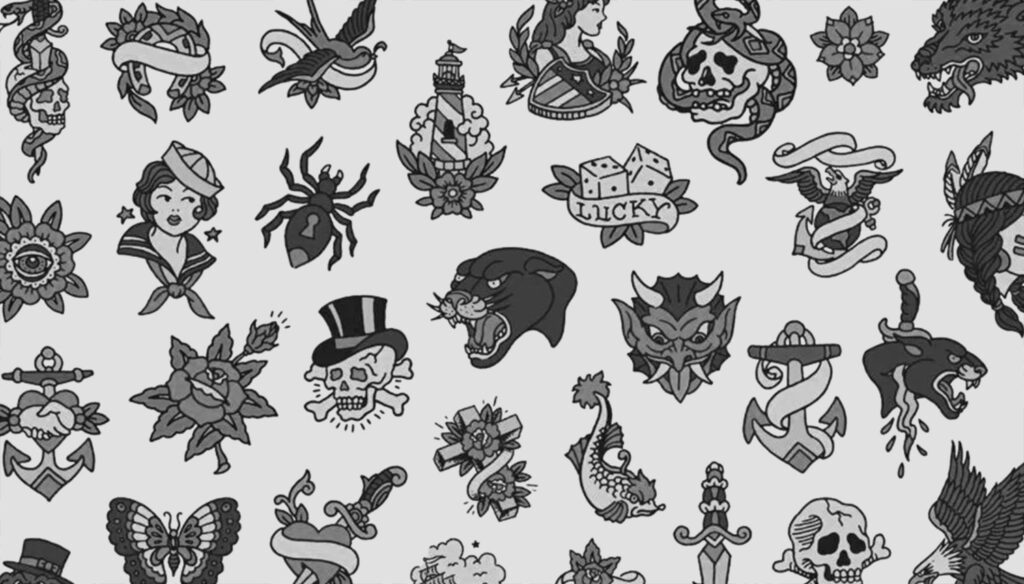
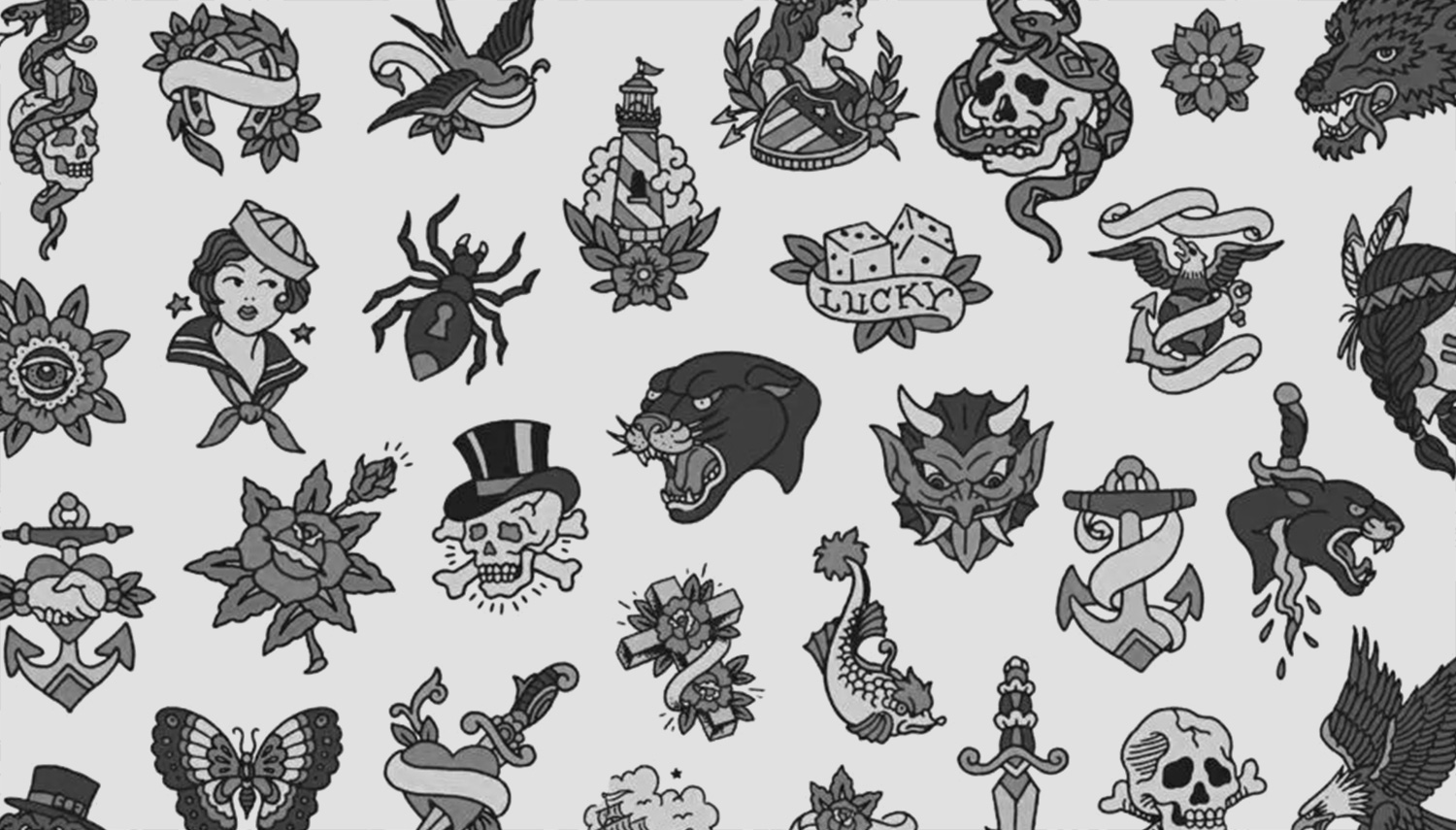
American Traditional (Old School)
AESTHETIC FAMILY
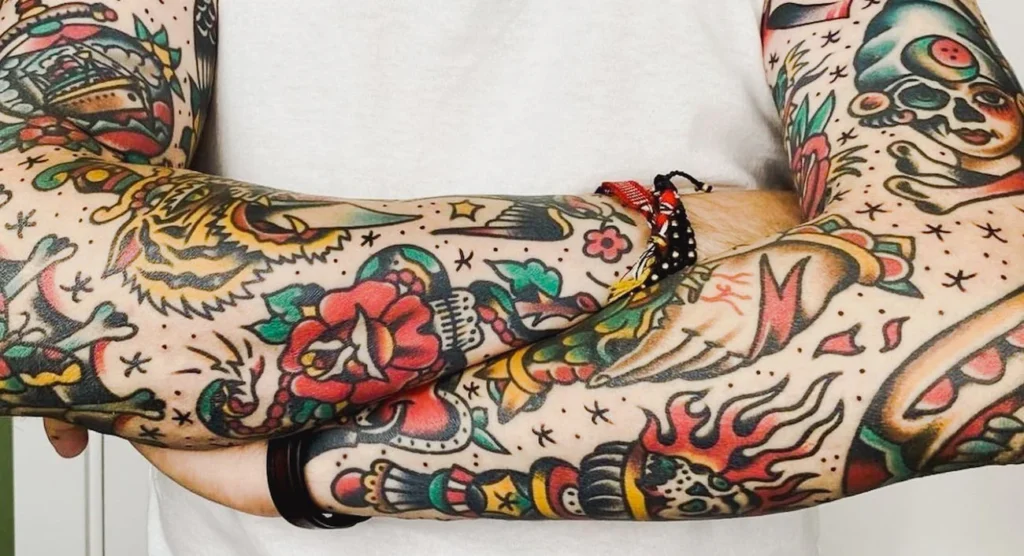
Bold black outlines, simplified iconic motifs from flash-sheet culture, and solid fields of colour built for legibility over decades, not just in photographs. The logic is simple: if a design can’t be read from ten feet away, it isn’t done.
Rooted in early 20th-century Western tattooing and strongly associated with Norman “Sailor Jerry” Collins (1911–1973), whose biography documents decades of refining the flash tradition. The “navy + exoticism” histories intersect with colonial contact narratives in the Pacific — a reminder that even a low-sensitivity style has consequences when it borrows symbols thoughtlessly.
Modern machine tattooing with thick line groupings and confident colour packing. Arms, chest, calves — readable zones. Patchwork collector sleeves are common. Classic limited palette: red, green, yellow, black, and not much else.
Key reference: Sailor Jerry (Norman Keith Collins)
Neo-traditional
AESTHETIC FAMILY; traditional-derived
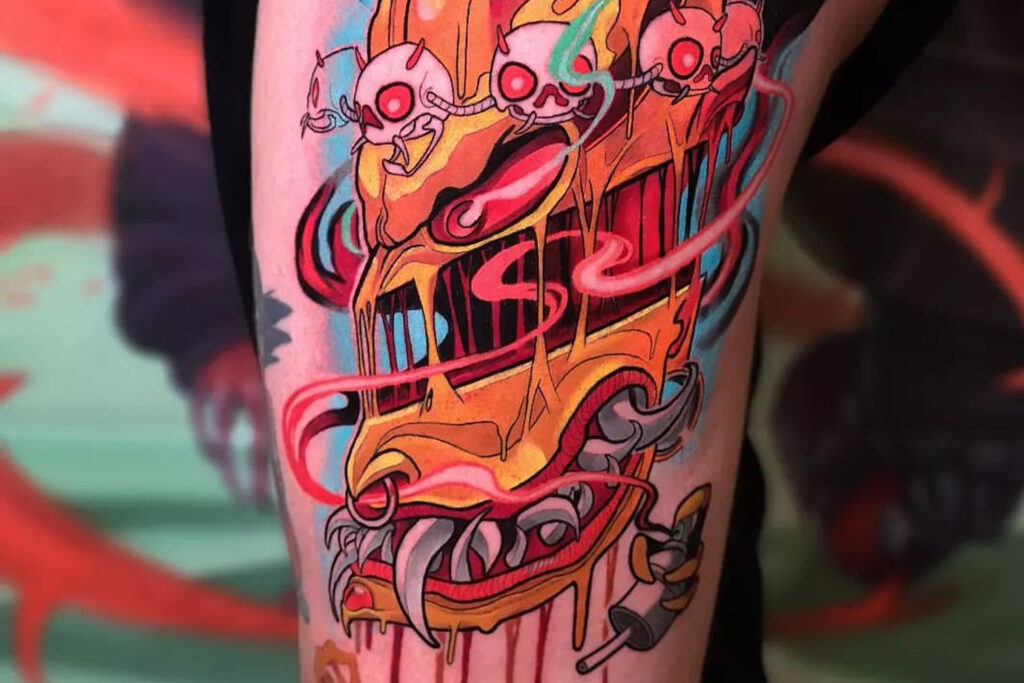
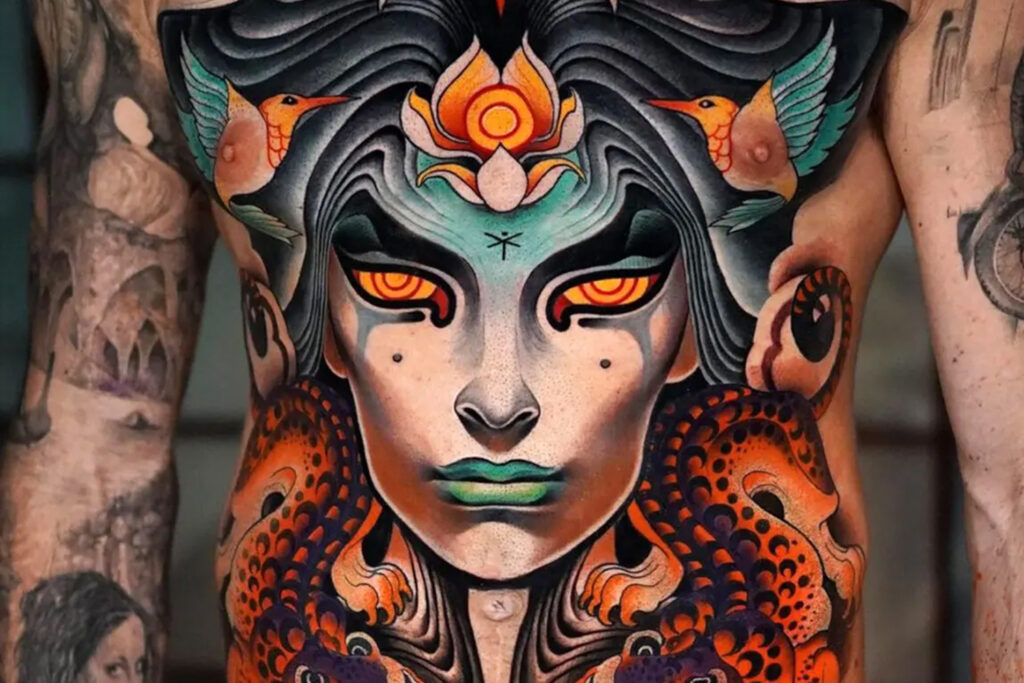
Keeps the Traditional backbone — outline discipline, motif confidence — but adds richer detail, dimensional shading, and broader, more dramatic palettes.
A late-20th-century evolution. Style literature describes it as a modern, dimensional extension of American Traditional: the palette and scale open up while structural clarity remains. Upper arms, thighs, backs — areas large enough for the detail. Machine tattooing with layered shading and varied line weights.
Key reference: Matt Truiano (official website).
New School
AESTHETIC FAMILY; pop/cartoon
Exaggerated proportions, rounded forms, punchy contrast, and heavy saturation. Cartoonish subjects, bold outlines borrowed from older “school” foundations. Origins are debated; most sources associate it with late-20th-century underground and pop culture crossover. Machine work with heavy colour packing.
Larger body areas — such as forearm sleeves, thighs, and backs — serve the style well. Compressed too small, the colours compete and blur.
Key reference: Jesse Smith (official website).
Realism (colour & portrait)
AESTHETIC FAMILY; technique-intensive
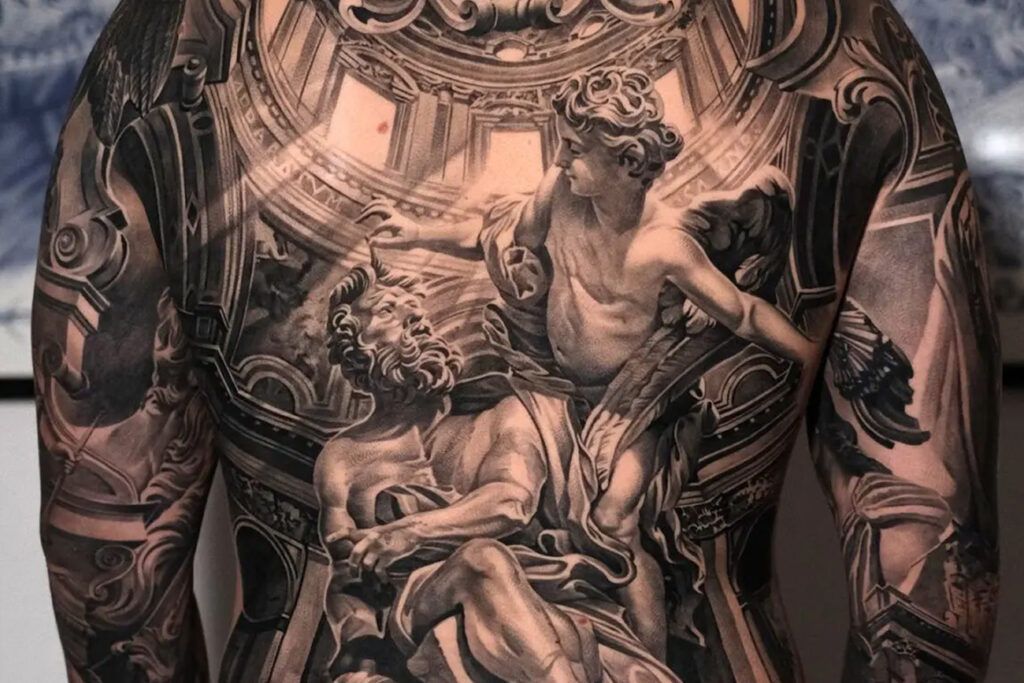
Photo-realistic detail, smooth gradients, and shadow mapping from reference photographs. The aim is to reproduce photographic reality rather than stylised imagery. Style guides trace tattoo realism to the influence of photorealism and pop art.
Forearm, thigh, back — flat, stable surfaces help realism age with fewer distortions. Either full colour or black-and-grey. Portraits demand subtle tonal control; religious and memorial imagery are common subjects, which means consent for portrait subjects and sensitivity around sacred imagery matter case by case.
Key reference: Nikko Hurtado (official website).
Microrealism
Often treated as a REALISM SUBSTYLE; classification disputed
Realism compressed into very small scale — tiny portraits, miniature animals, objects rendered in fine detail — where selective focus and simplified backgrounds help the tattoo hold up as it ages. Realism style guides bundle Micro-Realism under the realism umbrella, though it overlaps heavily with fine-line technique.
A 2010s–2020s expansion enabled by fine machine control and growing demand for delicate aesthetics. Low-friction areas (inner forearm, upper arm, calf) tend to preserve micro detail better. Often black-and-grey or muted colour.
Key reference: Bang Bang Studio (official website), which positions multiple artists as “micro style and single needle.”
Black & Grey / Chicano
PALETTE LABEL + culture-rooted movement; often conflated
“Black & Grey” is a tonal approach. “Chicano” is a historically and politically rooted LA/Mexican-American tattoo movement that often uses black-and-grey shading, fine line detail, and Catholic/heritage iconography. Conflating the two flattens the politics out of the picture.
Chicano tattooing is framed through Los Angeles history and political heritage. Interviews with Dr. Woo connect modern fine-line demand to mentorship under Mark Mahoney, a key single-needle black-and-grey figure. The sensitivity is real but not absolute: it’s not a closed Indigenous protocol, but it is deeply communal and easily caricatured. It also intersects with prison-lineage imagery, in which symbols can carry unintended meanings for outsiders.
Greywash layering and fine-line single-needle aesthetics. Arms and chest for portraits; hands, knuckles, and torso for script.
Key references:
- Mark Mahoney (Shamrock Social Club), described by his own studio as a “founding father” of single-needle black-and-grey.
- Mister Cartoon, with roots in cholo graffiti and LA culture.
Fine line
TECHNIQUE LABEL; “style” is disputed
What makes a tattoo “Fine Line” is primarily needle gauge and typically round liner/single-needle foundational linework. The result is a hair-like aesthetic — delicate, intricate, well-suited to phone screens. The modern boom is tied to Instagram-era demand. Dr. Woo describes the platform changing client requests and his own shift toward single-needle work under Mark Mahoney’s mentorship.
Wrist, forearm, ribs — quiet-tattoo zones. Usually black or grey. Fine line is often used to render culturally sensitive motifs in a “minimal” way that still carries meaning. Research your symbols before committing.
Key reference: Dr. Woo (official website), widely recognised for intricate single-needle work.
Minimalism / micro
AESTHETIC DIRECTION; overlaps with fine line
Small symbols, single continuous lines, negative space, and restraint as a design principle. Often enabled by fine-line technique but defined more by what it leaves out than what it puts in. A modern popularity pattern rather than a historic school.
Ankle, wrist, behind ear, inner arm — visibility control is part of the appeal. Mostly black.
Key reference: Mo Ganji (official website), whose one-line tattoo practice defines the minimalist end of the spectrum.
Blackwork
UMBRELLA; overlaps with “tribal” histories; classification debated
Blackwork is defined broadly as tattoos made exclusively with black pigment, including thick outlines, bold solid areas, and deliberate negative space (“skin breaks”). The category is wide enough to contain graphic art, pattern work, and large-scale body coverage.
Many blackwork genealogies run through “tribal” revivals, and that is where appropriation debates concentrate. Blackwork can be purely graphic, but “tribal-looking” motifs can unintentionally reference Polynesian, Māori, or Sāmoan systems where designs are not generic decoration. Sleeves and backs are common because large shapes and negative space need area.
Key reference: DotsToLines / Chaim Machlev (official website).
Blackout
Extreme blackwork; functional + aesthetic
Large fields of solid opaque black ink — covering old work completely or serving as a deliberate minimalist choice. Tattooing 101 distinguishes blackout as its own phenomenon, separate from blackwork’s more textured range.
Arms and legs are common due to the contiguous surface area. May require multiple sessions. Sensitivity rises when blackout compositions borrow Indigenous pattern structures as framing devices.
Geometric
AESTHETIC FAMILY; design-driven
Precision geometry, symmetry, and deliberate alignment to the body’s anatomy. DotsToLines describes geometric tattoos and flowing linework as defining features of the practice. Sternum, sleeves, and back — areas where symmetry can track the body’s axes.
A modern tattoo genre strongly influenced by contemporary design culture. Usually black. Sensitivity is low unless motifs are explicitly sacred or religious to a living tradition.
Key reference: Chaim Machlev / DotsToLines (official website).
Dotwork
TECHNIQUE LABEL; often treated as style
Shading built from dot density rather than continuous ink flow — images emerge from accumulation rather than stroke. Can be machine- or hand-applied; the technique is adaptable across aesthetics.
Often linked conceptually to pointillism. Upper arm, shoulder, back — areas where gradients read well. Usually black or grey.
Ornamental / mandala
AESTHETIC FAMILY; motif-driven; sensitivity varies
Decorative patterning: mandalas, nature-derived ornament, lace and filigree symmetry. Tattoodo names mandalas as frequent motifs. A modern tattoo category drawing from many older decorative and spiritual visual systems.
When clients want “a mandala because it’s pretty,” the risk is flattening religious and spiritual meaning into wallpaper.
Responsible practice includes acknowledging origins and avoiding sacred scripts you don’t understand. Sternum, spine, shoulders, hands, and feet. Precision stencilling, line consistency, and often dotwork shading.
Key reference: DotsToLines lists mandala and dotwork alongside geometric in the artist’s portfolio categories.
Watercolour
AESTHETIC; painterly; longevity debates are common
Brushstrokes, washes, splatters, and painterly diffusion — often without heavy outlines. The museum exhibition text for Amanda Wachob states that in 2008, she pioneered a tattoo style incorporating brushstrokes, washes, and splatters, commonly known as the “watercolour technique.”
The central controversy is practical — how will it age? — rather than cultural. Colour-heavy by definition. Forearm, shoulder, thigh — medium surfaces that support gradients. Many artists anchor washes with subtle structural linework underneath.
Key reference: Amanda Wachob (official website).
Illustrative
AESTHETIC FAMILY; drawing-forward
Tattoos that retain a drawn or illustrated feel — etching, engraving, sketch gesture — borrowing across art movements rather than committing to one. Tattoodo’s illustrative guide emphasises this breadth as a defining quality. A category for translating illustration languages into skin rather than a single origin story.
Linework, hatching texture, deliberate stylisation. Scales from small to large, though narrative scenes need room.
Key reference: Jesse Smith (official statement: “quirky, colourful, illustrative-based art”).
Script / lettering
TECHNIQUE + typographic craft
Monolith Studio describes script and calligraphy as the most popular tattoo category, spanning casual handwriting to formal calligraphic traditions. Font errors are permanent.
Blackletter/Gothic carries historical and religious weight. Chicano scripts can be reduced to “a vibe” and detached from community meaning. Forearm for the “reading lane,” ribs for longer phrases, collarbone and spine for linear text.
Key references:
- Mark Mahoney (fine-line black-and-grey lineage).
- Mister Cartoon (lettering + LA cultural roots).
Biomechanical
AESTHETIC FAMILY; sci-fi body illusion
Torn skin revealing machinery underneath, sometimes divided into biomechanical (machine-infused) and bioorganic (natural-only). The lineage runs directly through H.R. Giger’s art universe; his museum describes environments modelled in the style of his biomechanical designs.
Arms and legs work best for the “wrap” effect; backs accommodate full scenes. Usually black and grey, sometimes with limited colour accents. Realism-adjacent shading creates depth, often over multiple sessions at a larger scale.
Key references: Guy Aitchison (Biomech Encyclopedia), a biomech community anchor.
Trash Polka
AESTHETIC FAMILY; origin well-documented
Chaotic collage combining realism and abstract/typographic elements with a distinctive black-and-red dominance. The creators’ official page states that Volker Merschky and Simone Pfaff opened Buena Vista Tattoo Club in Würzburg in 1998, that Trash Polka developed into a style, and that it is a registered trademark.
A studio-originated style, not an Indigenous heritage system. Large body areas — back, thigh, sleeves — because collage needs space. Black and red, always.
Key reference: The creators – Trash Polka (official website).
Handpoke
TECHNIQUE LABEL; not inherently a separate aesthetic
Non-electric tattooing. Tattoodo describes handpoke as tattoos applied using a single needle dipped in ink rather than an electric machine. Hand methods are ancient worldwide, but “handpoke” as a modern label rises with the contemporary craft revival.
Low sensitivity when treated as a method; the risk rises when it’s used to imitate culturally restricted tapping traditions without context. Manual puncture with sterile needles. Often small-to-medium pieces; large projects are possible but time-intensive. Usually black.
UV / blacklight tattoos
NICHE; chemistry varies
Tattoos using pigments that fluoresce under UV light are sometimes subtle or nearly invisible under normal conditions. A niche modern practice; material standardisation remains limited in publicly available sources. Often chosen for discretion.
Cyber-sigilism
TREND LABEL; classification disputed; culturally sensitive comparisons
Cyber-sigilism is described as glitchy digital aesthetics fused with magical-looking glyphs — “futuristic spells.” Monolith describes thin black lines, sharp geometrics, glitch-like patterns, and symbolic abstraction.
The term was coined or popularised by LA-based artist Aingelblood, who faced resistance in 2018 before mainstream growth. Critics liken it to the “tribal tattoos of previous decades,” raising questions of appropriation; El País documents the broader controversy and the power dynamics involved.
Fine-line heavy, often large, body-hugging compositions. Spine, back, forearms, neck, and hands are common. Mostly black. Technique overlaps significantly with fine line and ornamental geometry.
Key reference: Aingelblood (official website), plus curated profiles in GQ.
Culture-bound traditions
Polynesian (general umbrella)
“Polynesian” is not a single style. It is a family of distinct island traditions. Common external markers include monochrome band-and-zone logic and motifs tied to social and spiritual meaning, but museums caution against flattening this diversity into a single generic “tribal.”
Archaeological and university sources report ancient tattooing comb toolkits in Tonga dated to roughly 2,700 years ago, demonstrating long continuity. Pitt Rivers Museum documents comb-like, serrated tools and pigment staining consistent with repeated use — the comb is struck to place pigment. Traditionally, large integrated body areas; exact placement rules vary by island culture and cannot be safely generalised.
Key references: Pitt Rivers Museum (Body Arts); Griffith University (Tonga toolkit research).
Sāmoan tatau (pe’a / malu)
Te Papa states: the pe’a is dense tattooing covering men’s lower bodies from the waist to the knees; the malu is the equivalent for women, covering the upper thighs to the backs of the knees with less density. These tattoos function as social contracts within fa’a Sāmoa.
Te Papa’s touring exhibition, Tatau: Sāmoan Tattooing and Photography, documents contemporary practice over the last 40 years through the work of four photographers. NZ Geographic references the seriousness and ritual intensity of receiving pe’a. Traditional methods include specialist tools and assistants; the process is ceremonial. Bangkok Post’s analogous critique of Sak Yant commercialisation illustrates how ritual marks can be reduced to tourist “menus” — a pattern that applies across culture-bound traditions.
Key references: Te Papa Collections; Te Papa touring exhibition (Tatau: Sāmoan Tattooing and Photography).
Māori tā moko and kirituhi
Te Papa describes tā moko as carved lines representing far more than a tattoo. Te Ara describes moko as uniquely grooved lines produced by uhi chisels. Te Aka Māori Dictionary defines kirituhi as “skin art, tattooing — non-traditional tattooing that is not done using Māori protocols or imagery.” The existence of “kirituhi” as a defined term signals an ethical boundary written into the language itself.
Te Papa notes that metals replaced bone in uhi manufacture by the 1840s during the contact period. Te Ara documents the trade in tattooed heads, which led to a steep decline in the practice — a historical fact that shapes contemporary sensitivity. Tā moko is identity-linked. Facial moko is especially culturally sensitive. Placement meaning is culturally structured and not reducible to a generic chart.
Key references: Te Papa (Tāmoko | Māori Tattoos); Te Ara (NZ encyclopedia); Te Aka Māori Dictionary (kirituhi definition).
Filipino batok (Kalinga; Apo Whang-od lineage)
Traditional Kalinga tattooing uses hand-tapped methods. Whang-od Oggay is the most widely referenced living practitioner in official and major media sources.
The Philippine Senate formally documented a resolution nominating Whang-od for GAMABA/National Living Treasures recognition. NCCA conferred the Dangal ng Haraya award for intangible cultural heritage. Official recognition emphasises preservation of traditional indigenous tattoo art, which makes the ethical stakes around imitation and commercialisation explicit.
Key references: Philippine Senate documentation; NCCA recognition coverage.
Thai Sak Yant
The Thailand Foundation explains Sak Yant as yantra tattooing that invites sacred powers and is often tied to protection; it notes that Sak Yant may use coloured ink or oil for those seeking invisible tattoos.
A scholarly MDPI article examines Sak Yant among Westerners, including questions of copyright and cultural appropriation. A Stanford library record frames Sak Yant as one of the “last living examples” of authentic traditional tattooing. Bangkok Post documents commodification concerns: tourist “menu platter” selection replacing traditional ajarn selection protocols. Back, shoulders, and chest appear commonly in cultural descriptions; placement rules can be tradition-specific.
Key references: Thailand Foundation (official cultural explainer); scholarly analysis (MDPI); Bangkok Post (commercialisation critique).
Sámi-inspired motifs
Contemporary tattoos are inspired by Sámi cultural expressions — especially duodji patterns, colours, and symbols — rather than a well-documented continuous Sámi tattoo tradition. The Finnish government report explicitly recognises Sámi rights to maintain, control, protect, and develop intellectual property over cultural heritage, traditional knowledge, and traditional cultural expressions.
Commentary and cultural policy discussion note that duodji has been subject to appropriation and that the power to decide and control cultural objects matters. The ethical issue is not how the tattoo is made but whether, with whom, and with what permission.
Key reference: Siida Sámi Museum (duodji presentation).
Ukrainian / Belarusian / Russian / Eastern European folk motifs
Tattoos translate embroidery, ornament, and folk design into skin: sleeves mimicking textile borders, red-and-black geometry, symbolic florals, or protest-era “coded pattern” aesthetics. The Museum of Ukrainian Craft and Cultural Studies describes vyshyvanka embroidery as a symbolic, skill-intensive cultural practice. Vyshyvanka is shared across Ukrainian and Belarusian folk costume traditions.
Medium sensitivity: motifs can be politically charged and identity-linked. Avoid flattening distinct nations into a generic “Slavic pattern.” Forearms, calves, and sleeves, where textile-border logic reads naturally. Often red and black.
Key reference: Museum of Ukrainian Craft and Cultural Studies (MUCCS).
Prison tattoos (regional systems)
Tattoos made within incarceration systems often function as biography and status codes. The Russian/Soviet tradition is the most thoroughly archived.
FUEL’s archive biography states that Baldaev recorded tattoos across the former USSR between 1948 and 2000; the Smithsonian describes the published collection as more than 3,000 tattoos. Copying prison-coded symbols can be dangerous, stigmatising, or ethically exploitative — and extremist symbols exist in prison ecosystems.
Key references: FUEL archive; Smithsonian Libraries.
Functional practices
Medical tattooing / scar camouflage / cover-up
Medical tattooing includes restorative pigmentation (nipple-areola after reconstruction, for instance) and corrective camouflage. Scar tissue takes pigment differently, so outcomes are less predictable. NHS resources describe nipple-areola tattooing as a way to restore colour and symmetry after reconstruction. The ethical core is consent, trauma-informed practice, and clinical hygiene.
Key references: Guy’s & St Thomas’ NHS Trust; Leeds Teaching Hospitals; specialist clinical literature.
Cosmetic tattooing (PMU, microblading, SMP)
PMU enhances facial features; microblading is a specific cosmetic tattoo method; SMP places tiny dots to mimic hair follicles. Cleveland Clinic describes SMP as depositing dots of pigment on the scalp to create the appearance of thicker hair. PMU is “permanent” in the sense that removal is difficult.
Face (brows, lips, liner) and scalp. PMU uses dedicated devices; SMP uses microneedles to apply grayscale pigment.
Key references: Cleveland Clinic; dermatology literature reviews.
Functional practices
Cultural sensitivity key:
- High = identity/ritual/community protocol central;
- Medium = strong community lineage or high risk of harmful misreading;
- Low = primarily aesthetic/technique (still: avoid hate symbols and respect religious imagery).
| Style | Origin (short) | Typical color | Technique signature | Typical placement | Cultural sensitivity |
|---|---|---|---|---|---|
| American Traditional | Early 20th century, Western flash | Bold limited palette + black | Bold outlines, solid fills | Arms, chest, calves | Low |
| Neo-traditional | Late 20th c. Traditional evolution | Rich, dramatic color | Varied line weights, layered shading | Thigh, upper arm, back | Low |
| New School | Late 20th c. underground/pop mix | Saturated brights | Cartoon exaggeration, big contrast | Large limbs, full-colour panels | Low |
| Realism (colour & portrait) | Modern photorealism influence | Full color or B&G | Smooth gradients, photo-based shadow mapping | Forearm, thigh, back | Low |
| Microrealism | 2010s–2020s miniaturization | Often muted | Micro-detail realism, fine needles | Inner forearm, upper arm | Low |
| Black & Grey / Chicano | LA/Mexican-American lineage | Black/grey | Greywash, fine detail, lettering | Arms, chest, hands | Medium |
| Fine line | Technique-based label | Usually black/grey | Single-needle / small liner look | Wrist, forearm, ribs | Low |
| Minimalism/micro | Platform-era aesthetics | Mostly black | Sparse motifs, negative space | Ankle, wrist, behind the ear | Low |
| Blackwork | Modern umbrella + older currents | Black only | Solid black + negative space | Sleeves, backs, torsos | Medium |
| Blackout | Contemporary extreme blackwork | Black only | Large-area saturation | Arms/legs/torso panels | Low–Medium |
| Geometric | Contemporary design-driven | Usually black | Precision symmetry, anatomical flow | Sleeves, sternum, back | Low |
| Dotwork | Technique label (stippling) | Mostly black/grey | Dots build shading and gradients | Upper arm, back, mandalas | Low |
| Ornamental / mandala | Global decorative genre | Usually black/grey | Symmetry, lace/filigree patterning | Sternum, spine, hands/feet | Medium |
| Watercolour | Modern painterly tattooing | Bright washes | Soft edges, brushstroke aesthetics | Forearm, shoulder, thigh | Low |
| Illustrative | Illustration/etching influence | Variable | Drawing-first; line + texture | Any, often medium-large | Low |
| Script/lettering | Typographic tattooing | Usually black | Letterform precision and spacing | Forearm, ribs, collarbone | Medium |
| Biomechanical | Sci-fi horror + Giger lineage | Often black/grey | 3D “under-skin machine” illusion | Arms, legs, backs | Low |
| Trash Polka | Würzburg, Germany (1998) | Black + red | Collage: realism + graphic chaos | Large surfaces (back/thigh) | Low |
| Handpoke | Technique label (non-electric) | Often black | Manual puncture, organic texture | Small-to-medium pieces | Low |
| UV / blacklight | Niche modern practice | Fluorescent under UV | Speciality pigments; less standardised | Often hidden areas | Low |
| Cyber-sigilism | 2018+ internet-era label | Mostly black | Fine-line glyphs, techno-mystic forms | Spine, arms, neck/hands | Medium |
| Polynesian (umbrella) | Oceania; diverse traditions | Traditionally dark | Hand-tapping comb tools | Large integrated body areas | High |
| Sāmoan tatau | Samoa; pe’a/malu forms | Traditionally dark | Traditional tatau protocol | Waist-to-knee / thigh zones | High |
| Māori tā moko & kirituhi | Aotearoa NZ | Traditionally dark | Uhi chisels, carved grooves | Face/chin (moko), other zones | High |
| Filipino batok (Kalinga) | Kalinga, Philippines | Traditionally dark | Hand-tapped thorn/stick tradition | Arms/chest (varies) | High |
| Thai Sak Yant | Thailand/SE Asia | Black or oil/invisible | Ritual authority + yantra diagrams | Back/shoulders common | High |
| Sámi-inspired motifs | Contemporary usage | Often black | Varies (no fixed historic canon) | Small symbols/bands | High |
| Eastern European folk | Textile/ornament translation | Red/black common | Pattern adaptation, symmetry | Forearms, sleeves, calves | Medium |
| Prison tattoos | Many; USSR/Russia documented | Often monochrome | Symbolic code; improvised contexts | Visible “signalling” zones | High |
| Medical / cover-up | Clinical-adjacent practice | Skin-tone blends, black | Micropigmentation + camouflage | Scars, areola, rework zones | Low |
| Cosmetic (PMU, SMP) | Beauty + medical crossover | Natural hues; grayscale | PMU devices/blades; SMP microdots | Face/scalp | Low |