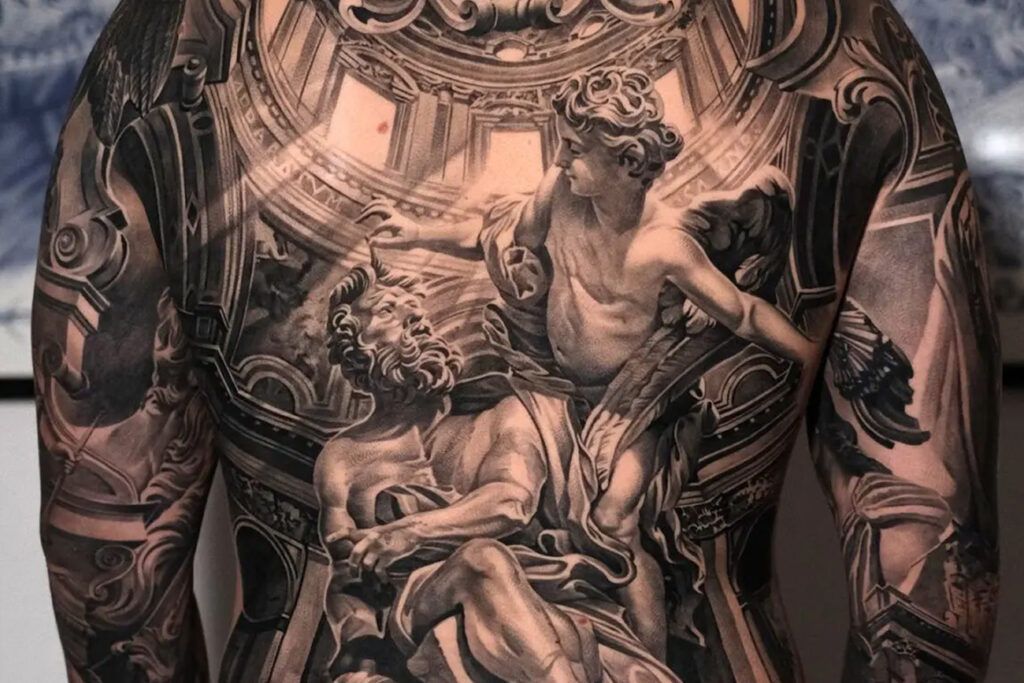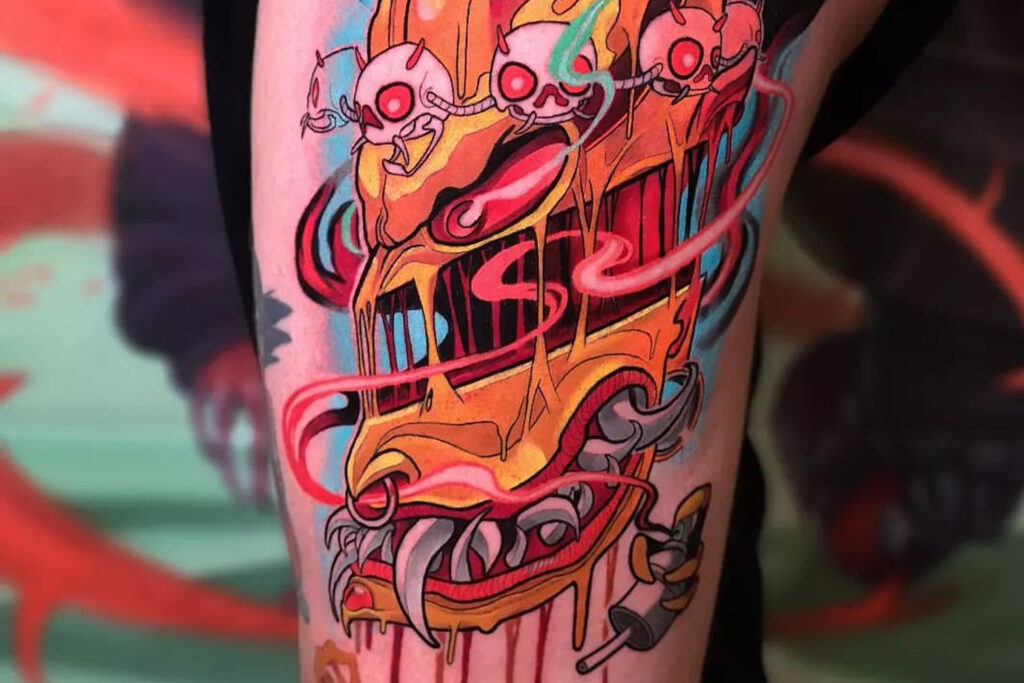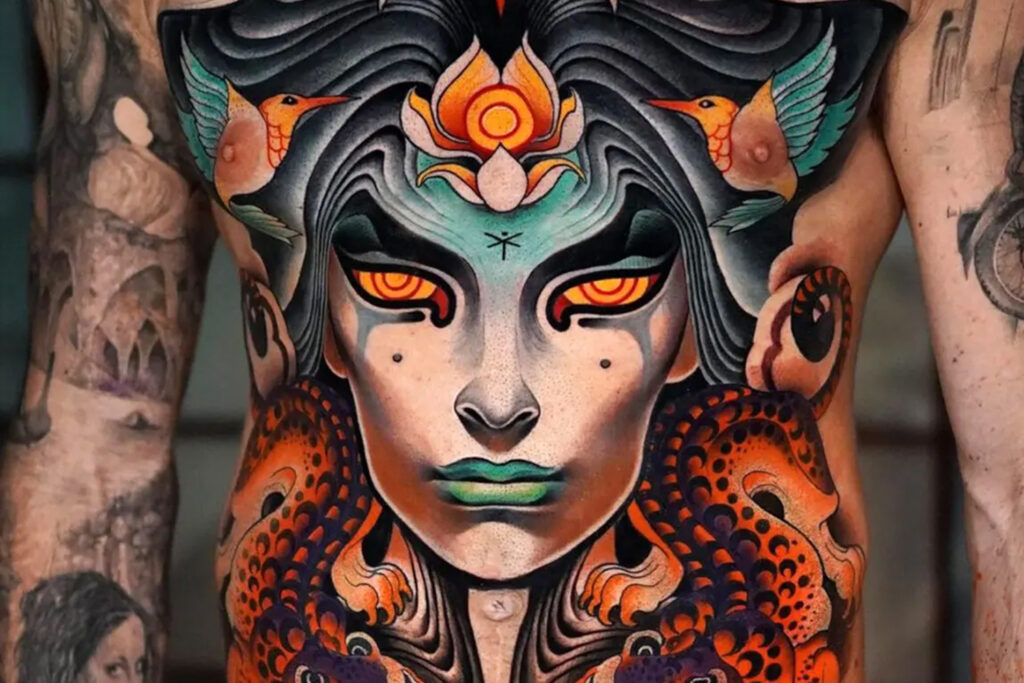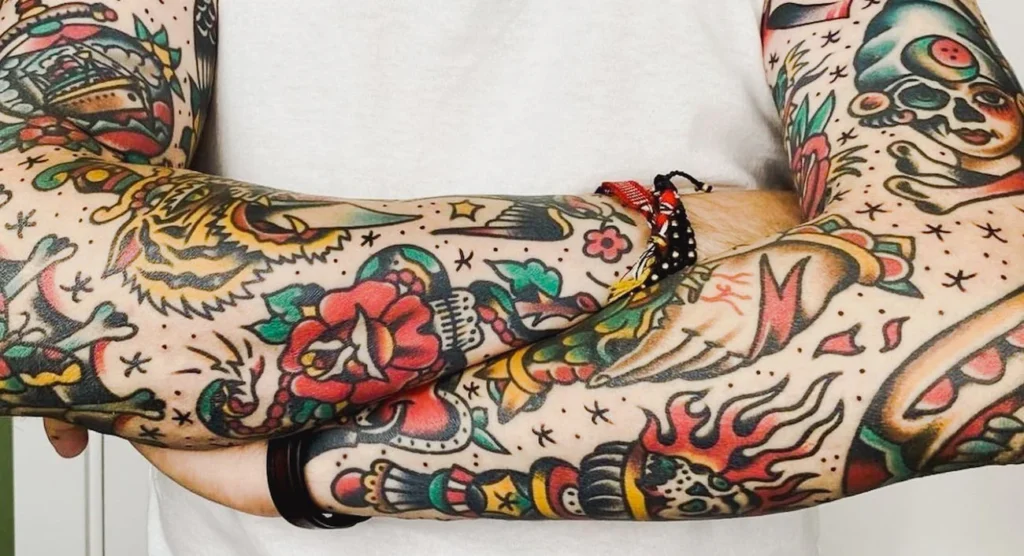

Neo-traditional
A style with one foot in the flash book
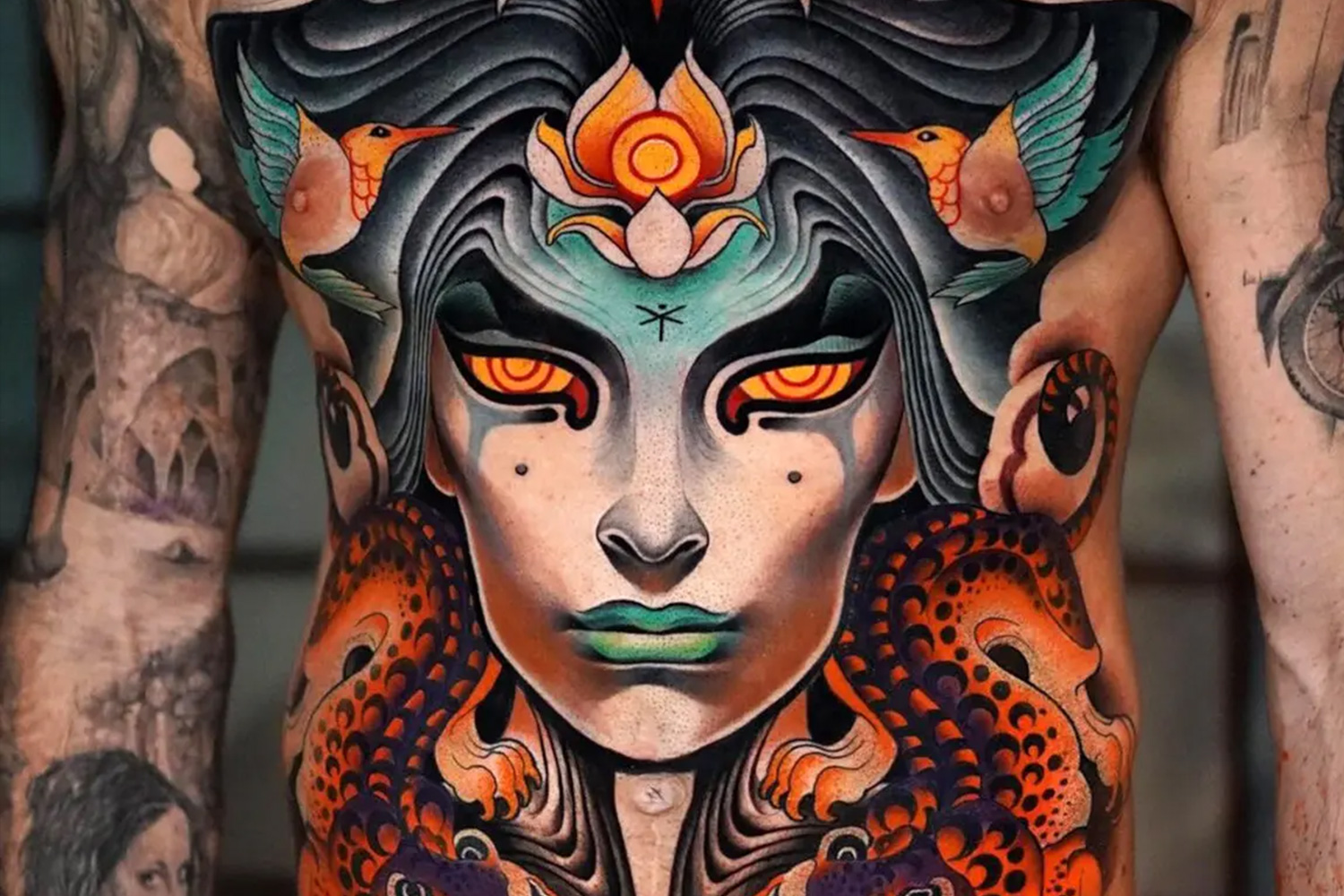
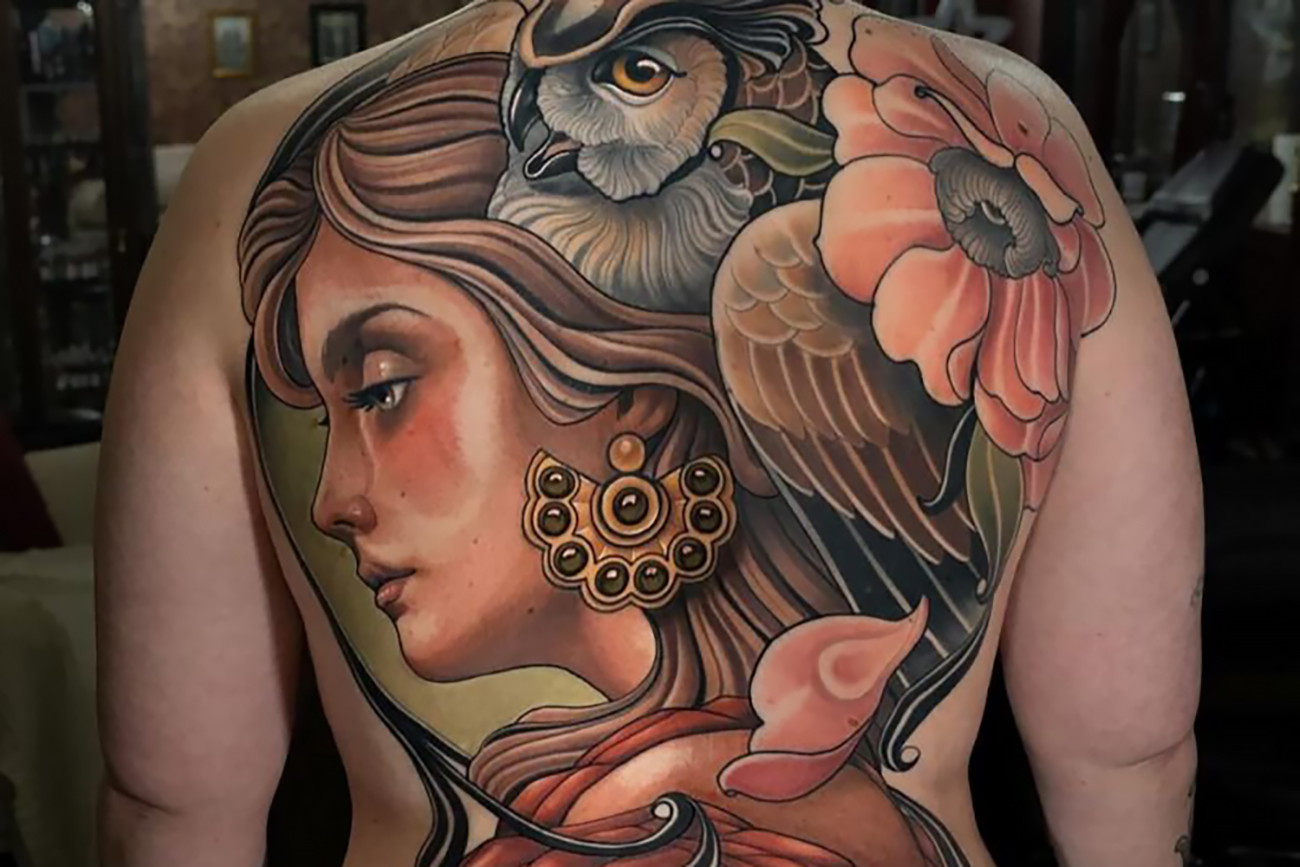
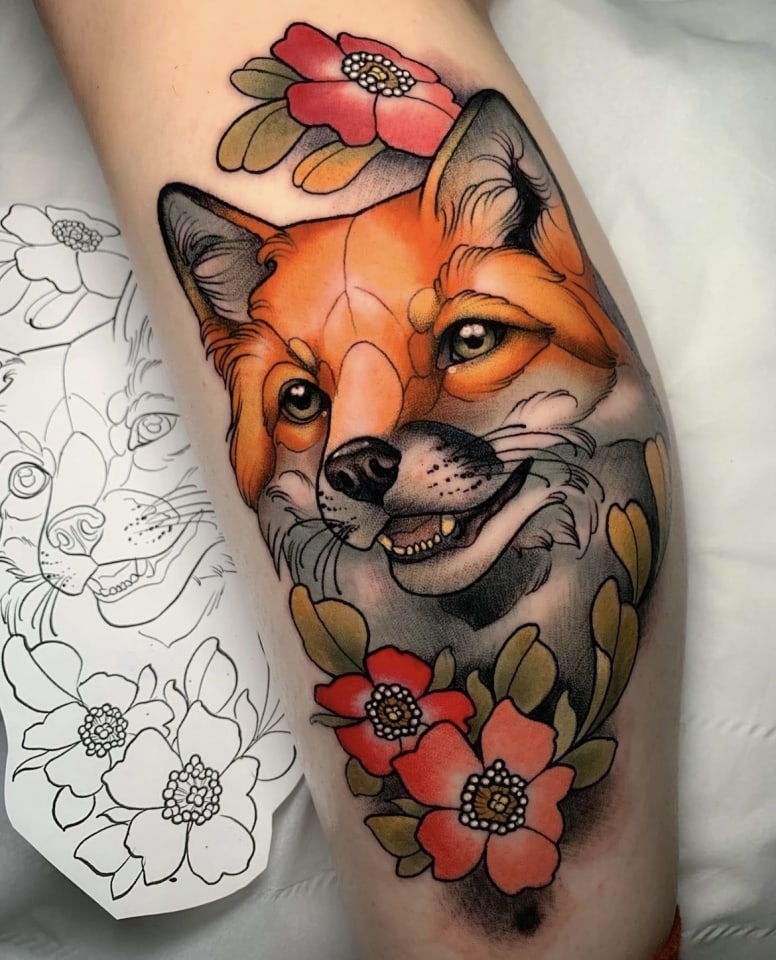
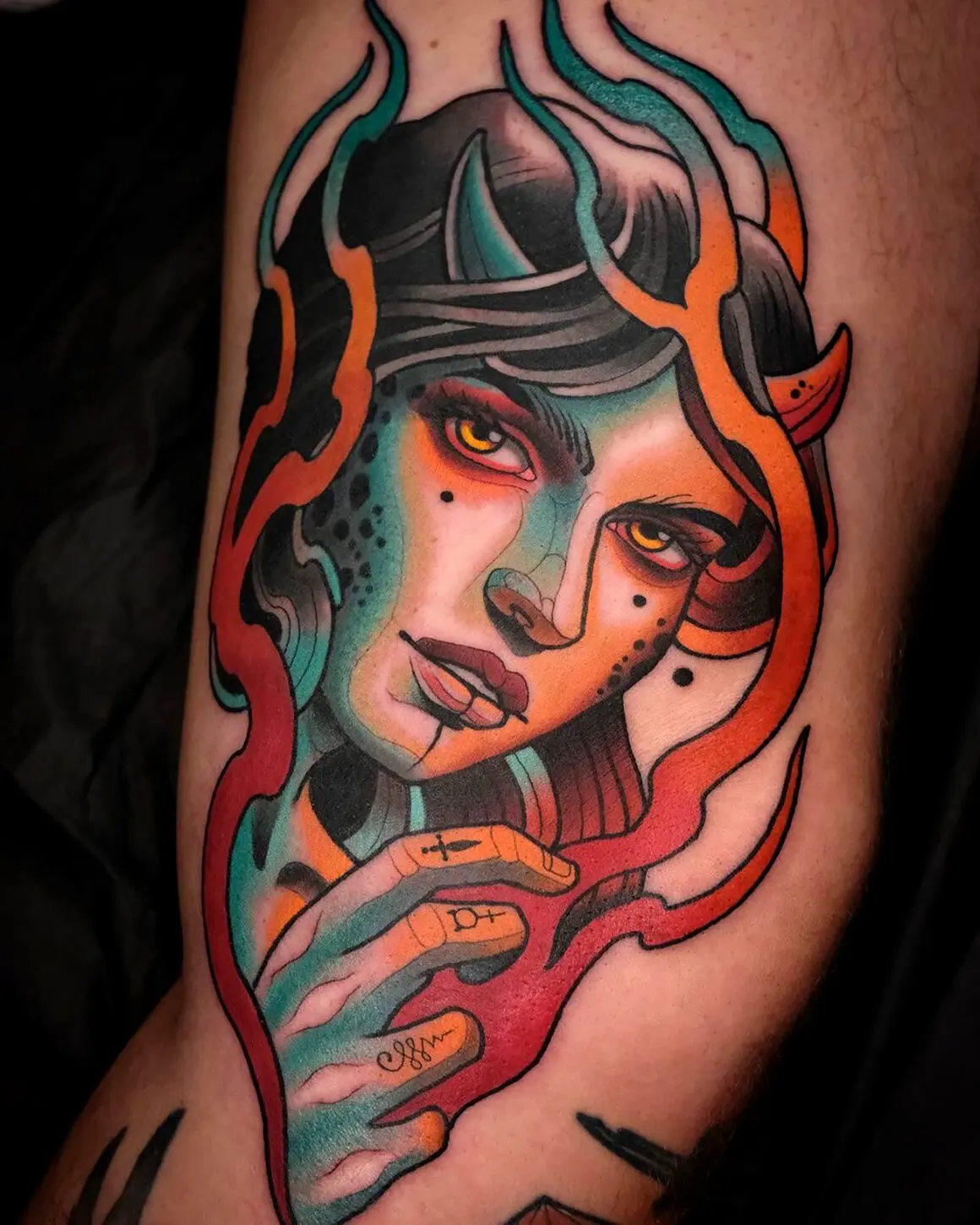
A fox with copper fur, green eyes, and a small bouquet of foxgloves between its teeth. A woman’s portrait framed by peonies, her hair rendered in fine parallel lines, her cheeks shaded in warm ochre over a pale underlayer. A stag skull draped in roses, drawn with the heavy outline of a flash design but filled in the colour range of a Dutch still life. These are the tattoos that defined neo-traditional in its first decade. The grammar is American traditional; the vocabulary has expanded into places the original tradition never went.
Neo-traditional has been the most requested tattoo style over the past fifteen years in most Western studios. It is also one of the most misunderstood. People often describe it as “traditional with more detail” or “traditional with more colour,” which is close enough to be useful and wrong enough to miss the point. Neo-traditional is a genuine extension of American traditional, governed by the same underlying principles of longevity and legibility, but drawing on a wider set of art-historical references and a broader palette than the original port-town shops ever had access to.
Where it comes from
The style emerged gradually in the 1990s and consolidated in the 2000s, which makes its history harder to pin to a single origin than that of the American traditional. A few things were happening at once.
The first was the pigment revolution. By the mid-1990s, tattoo ink manufacturers were producing reliable colours that earlier generations could only approximate: mid-tone purples, clean teals, ochres, muted pinks, earth browns that held their tone rather than drifting grey. The available palette expanded substantially over two decades, and this expansion alone opened compositional possibilities that had previously been technically unavailable.
The second was the influence of European and Russian art nouveau, Dutch and Flemish still life, Japanese ukiyo-e, and Victorian natural history illustration — all of which had been sitting in reference books and on museum walls while American traditional was being worked out in harbour-town shops. Tattooers trained in fine art began importing composition strategies and colour theory from these sources while keeping the structural bones of the traditional shop style.
The third was a generational shift in who was getting tattooed. By the late 1990s, the customer base had broadened well beyond the original working-class clientele. Clients wanted pieces with the durability and graphic weight of traditional work, but with imagery that reflected broader interests: folklore, literature, ornithology, botanical illustration, and personal iconography not found on a standard flash sheet. Artists responded by developing a vocabulary capable of handling custom requests without sacrificing the technical logic that made traditional work last.
Several artists are cited as early figures in the style’s consolidation, though the attribution is contested, and any short list leaves people out.
- Jeff Gogué, Chad Koeplinger, Russ Abbott, Jime Litwalk, and Myke Chambers in the United States.
- Emily Rose Murray, Jo Harrison, and Claudia de Sabe in Europe.
- Antonio Macko Todisco in Italy.
What these artists shared was a commitment to the outline-and-shading logic of traditional work combined with a willingness to draw from outside the traditional flash vocabulary.
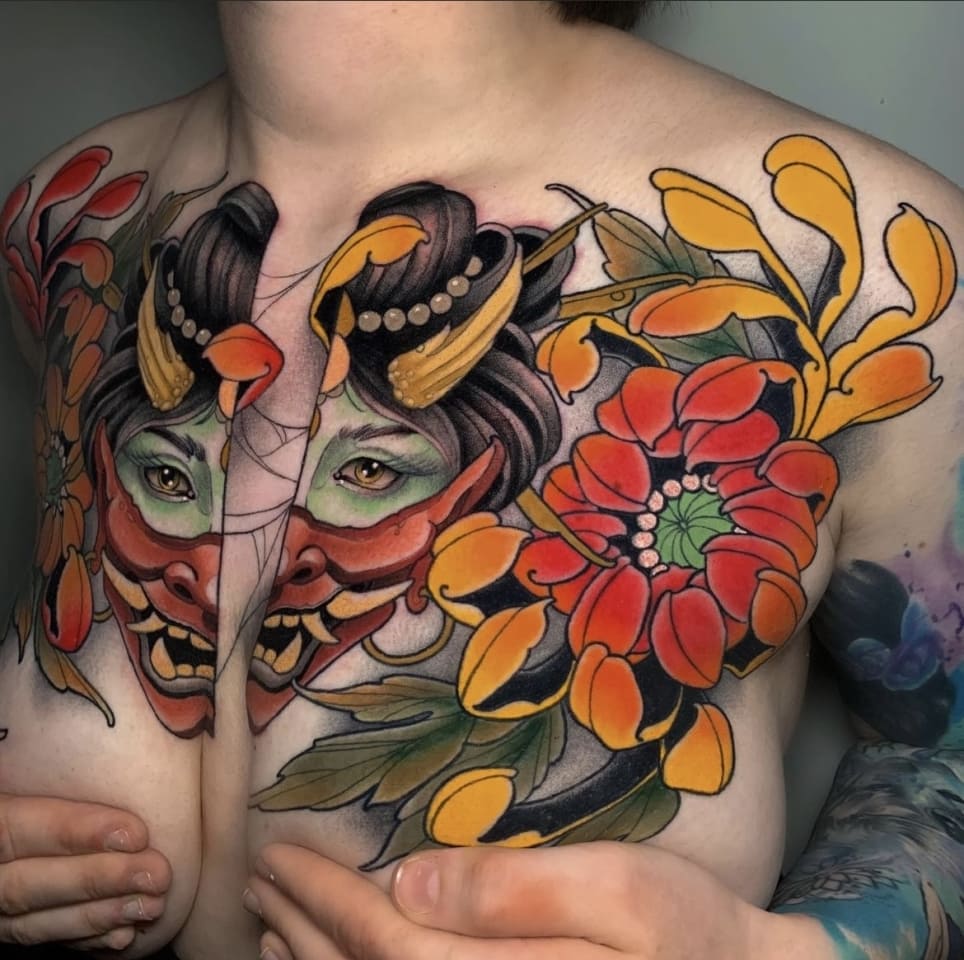
What makes a tattoo neo-traditional
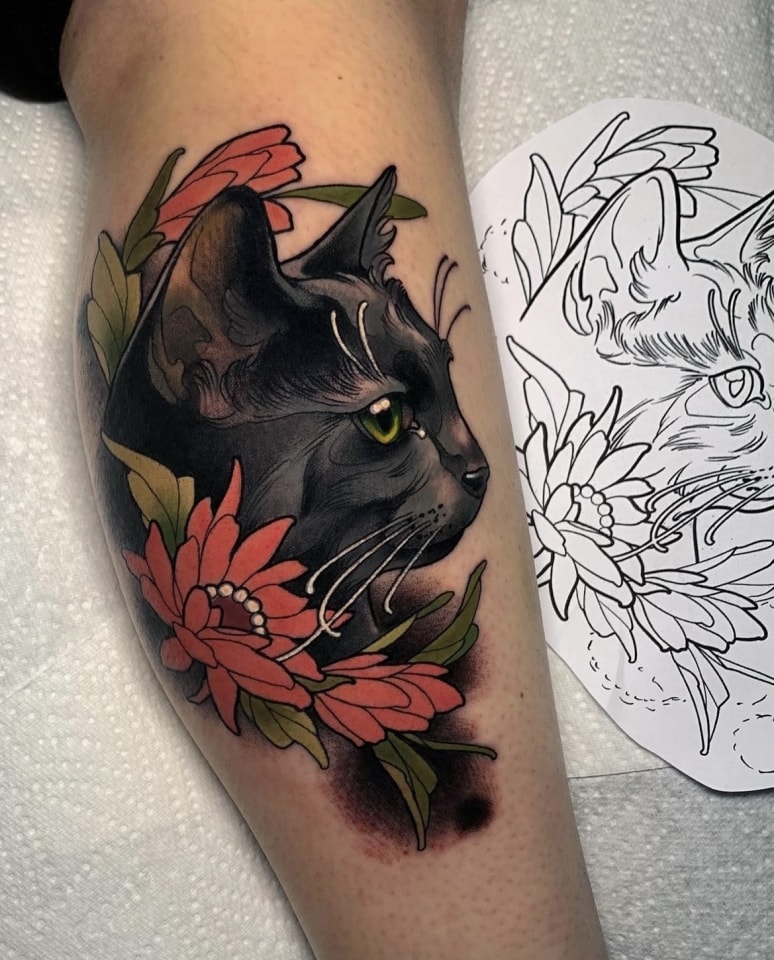
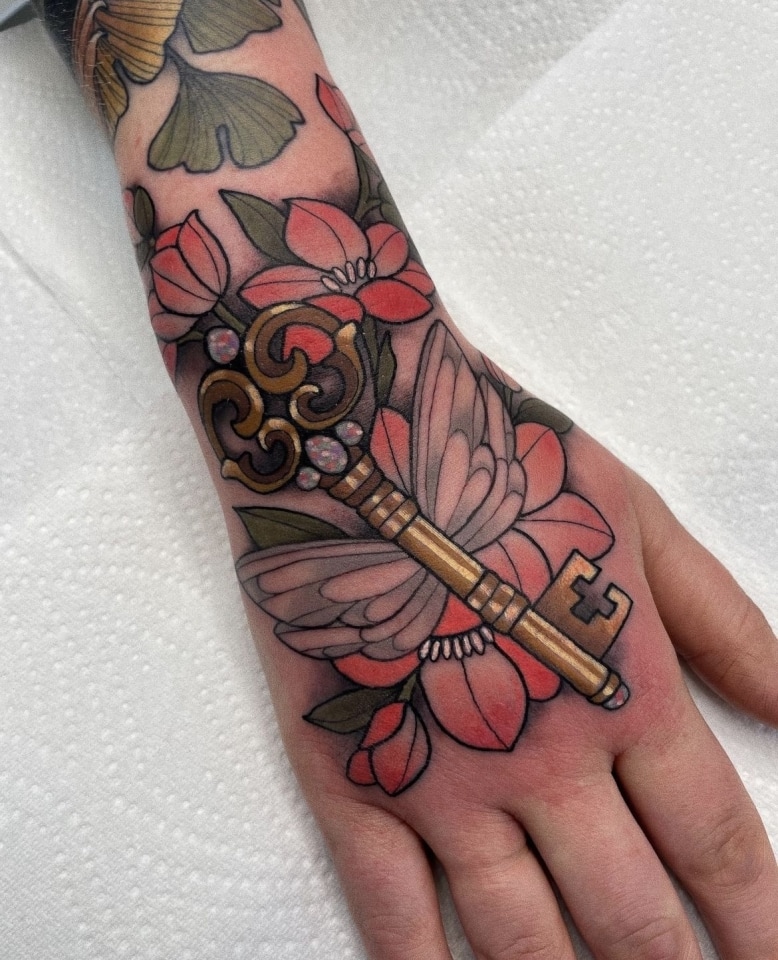
The style has a set of recognisable characteristics, even if its boundaries with other styles (especially illustrative and the so-called “new traditional”) are sometimes fuzzy.
The outline remains.
The palette is expanded but still controlled.
Shading is smoother.
The imagery is broader.
The composition is more elaborate.
Decorative elements are drawn from ornamental traditions.
What separates it from adjacent styles
Neo-traditional sits next to several other styles, and the edges blur enough that it is worth being clear about the differences.
American traditional is the parent. The differences are palette, shading technique, range of imagery, and compositional density. A traditional rose has two or three flat colour tones; a neo-traditional rose has six or seven with smooth gradients, often including colours no traditional artist would have used. A traditional piece usually sits alone on skin; a neo-traditional piece usually has ornamental framing.
Illustrative work uses the same expanded palette but often abandons the heavy outline, or uses a much finer line that reads as drawing rather than tattoo. An illustrative piece wants to look like a page from a book. A neo-traditional piece wants to look like a tattoo that took cues from a book.
New school is a different style despite the similar name. It emerged in the 1990s — associated with artists including Marcus Pacheco and Joe Capobianco, among others — and is characterised by extreme exaggeration of form: cartoon-like proportions, bright saturated colour, heavy outlines that swell dramatically. Neo-traditional is more restrained and draws from fine art rather than from animation and comics.
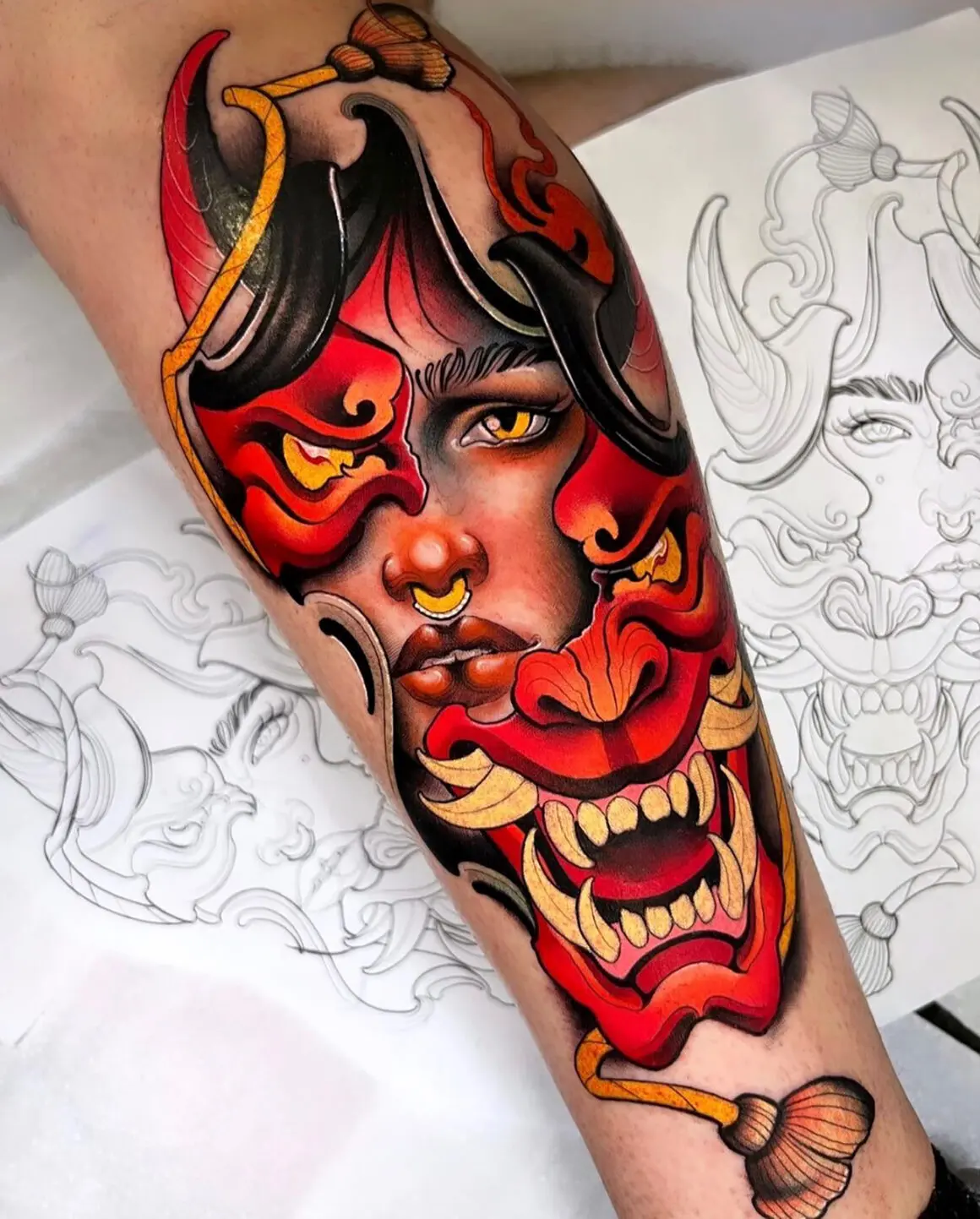
Neo-Japanese uses similar principles — traditional structure with expanded colour and modern composition — but within the Japanese iconographic and compositional system. The two styles are parallel developments in different traditions.
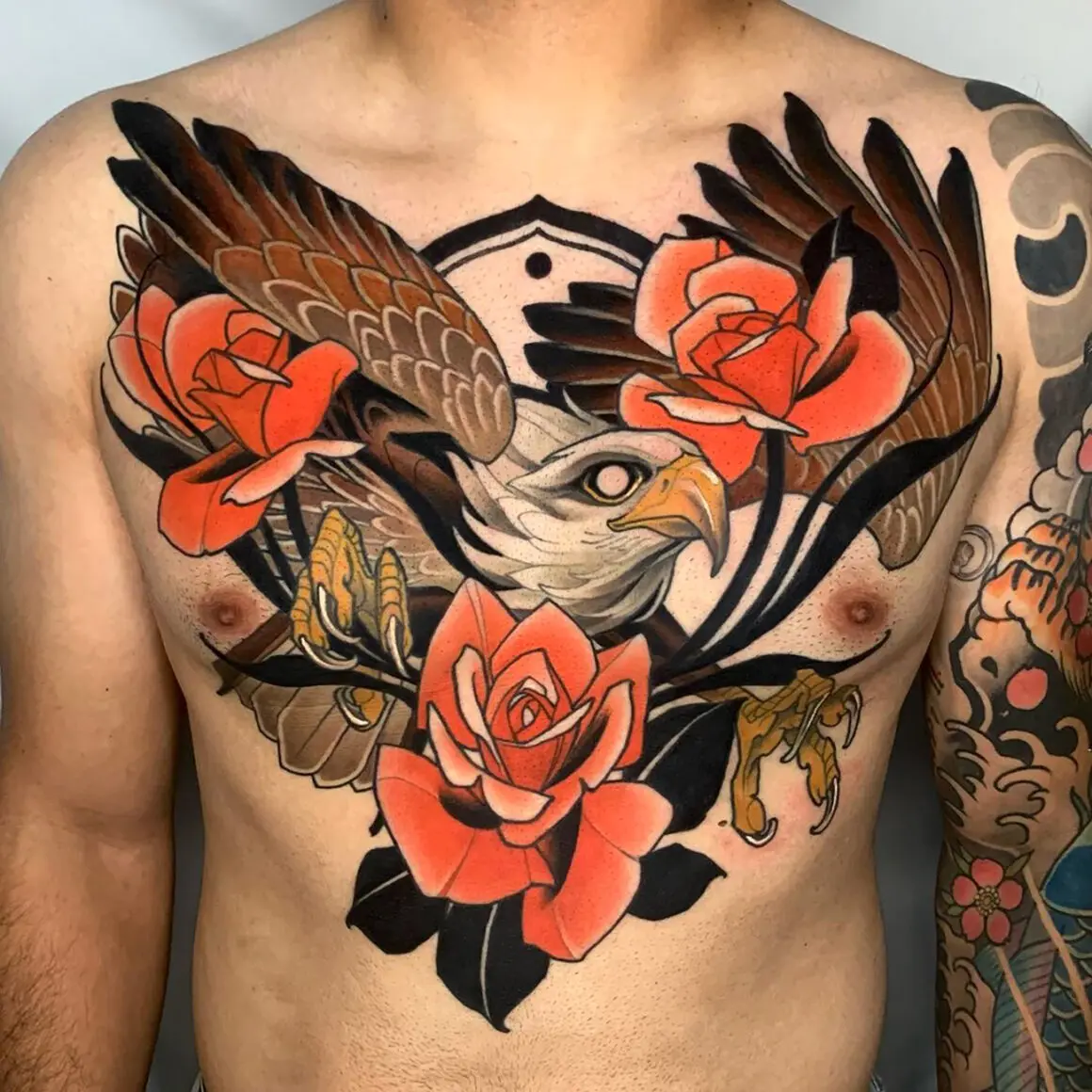
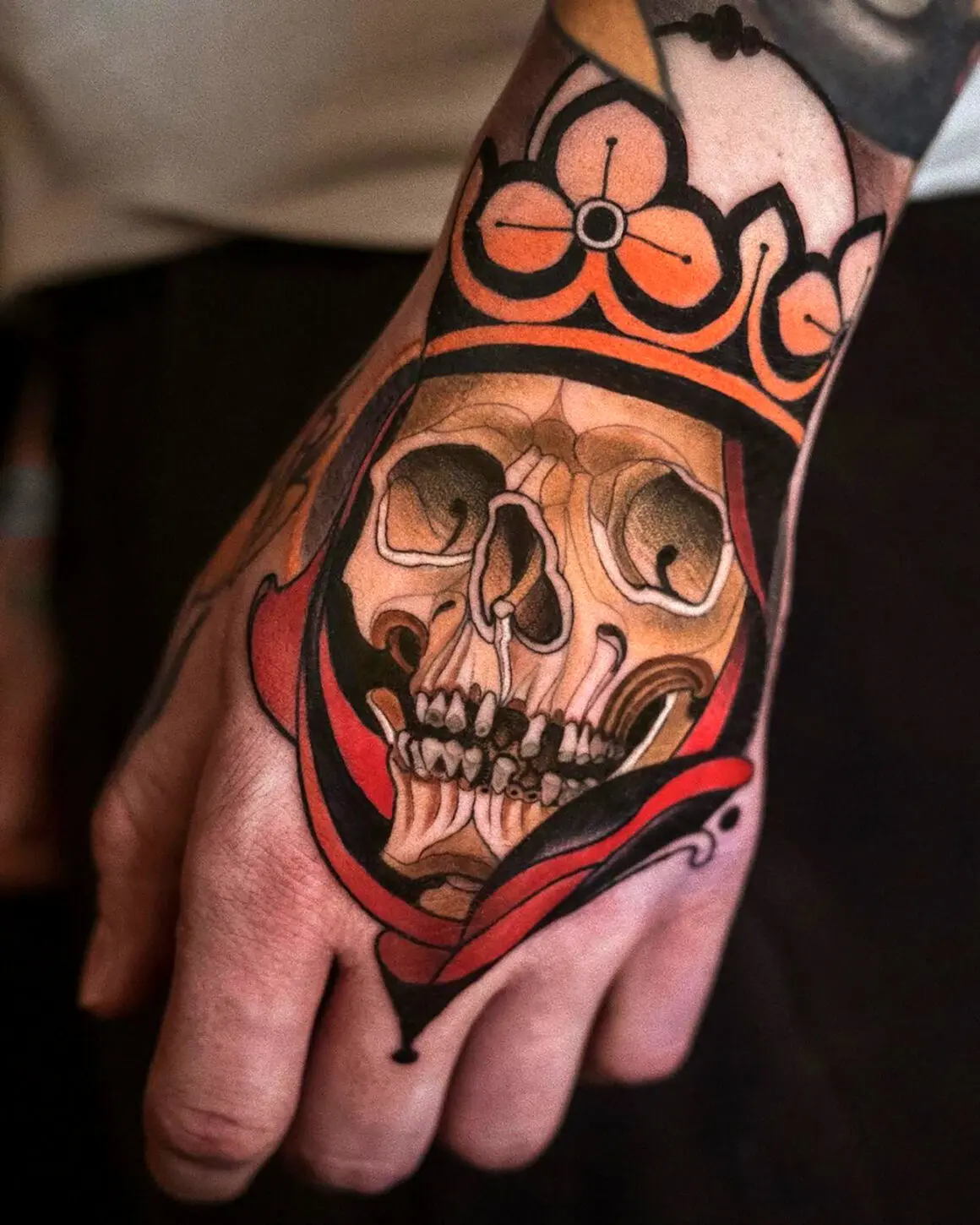
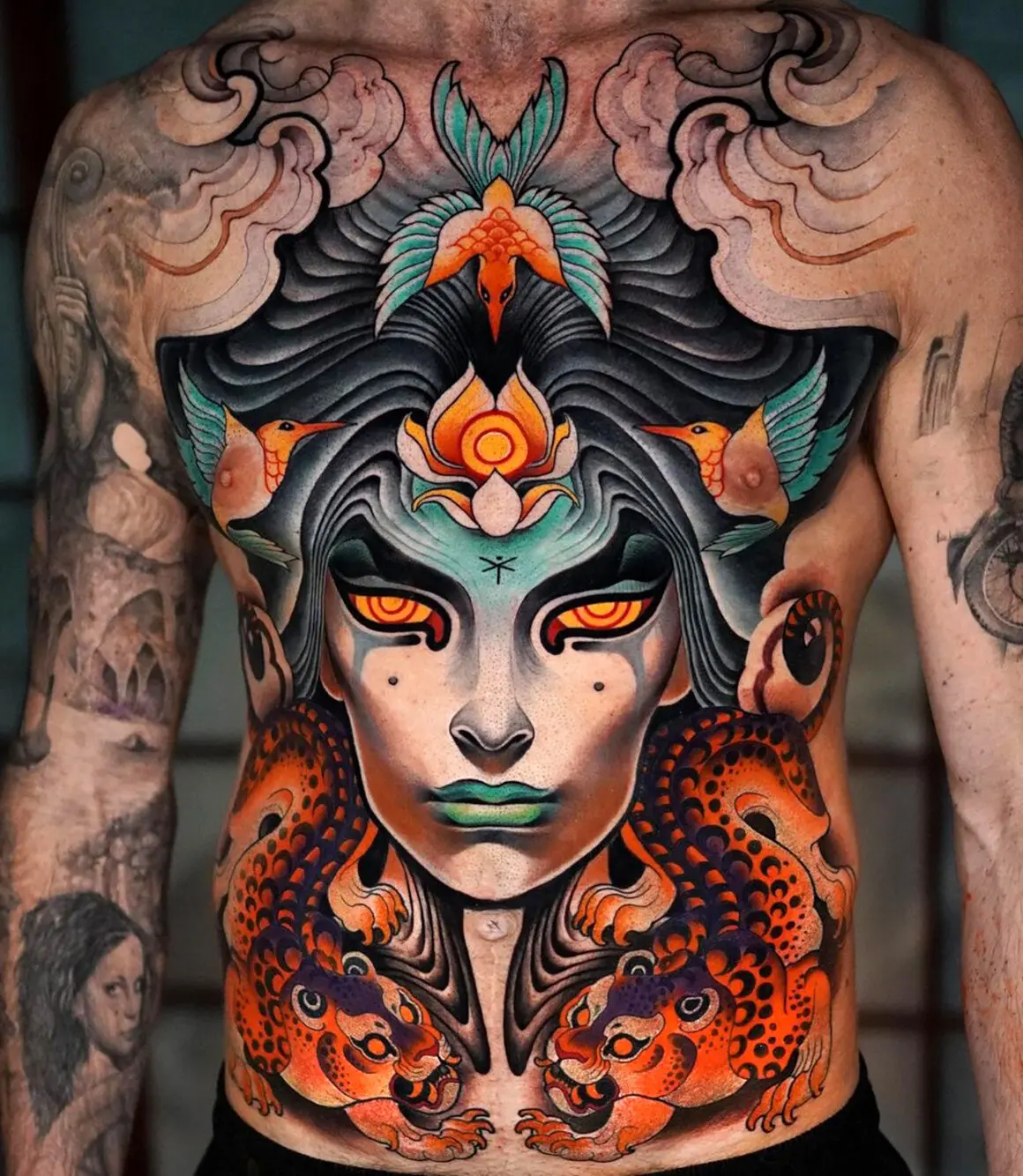
Imagery and its sources
Alphonse Mucha and Art Nouveau poster art are probably the single most influential visual influences. Mucha’s framing devices — women surrounded by circular haloes of stylised foliage, draped fabric rendered in elegant curves, ornamental borders integrated with the central figure — appear constantly in neo-traditional portraits and have shaped the style’s approach to composition.
Dutch and Flemish still life painting — particularly the tradition of flower pieces and vanitas — inform the colour sensibility and the treatment of botanical subjects. The deep background tones, the careful rendering of individual petals and leaves, and the memento mori imagery (skulls, candles, hourglasses) all appear in the neo-traditional repertoire.
Victorian natural history illustration, including the work of Ernst Haeckel and the plates from nineteenth-century ornithological and entomological books, is the source for much of the animal and insect imagery. The stylised anatomical accuracy — specimens rendered with scientific detail but presented in decorative compositions — is a direct import.
Japanese ukiyo-e contributed to the composition and treatment of wind, water, and natural backgrounds in large-scale works. However, this influence is more evident in neo-Japanese than in neo-traditional.
Eastern European and folk art traditions, including Russian lubok, Polish papercut art, and Scandinavian rosemaling, have influenced a significant European branch of the style, producing neo-traditional work with a distinctive folk-ornamental flavour that differs from the more art-nouveau-inflected American branch.
Fairytale and folklore illustration, particularly from the golden age of children’s book illustration (Arthur Rackham, Edmund Dulac, Kay Nielsen), provides much of the narrative imagery that distinguishes neo-traditional from the more symbolic American traditional vocabulary.
Technical considerations
The craft demands in neo-traditional are different from those of the American traditional, and, in some ways, more difficult.
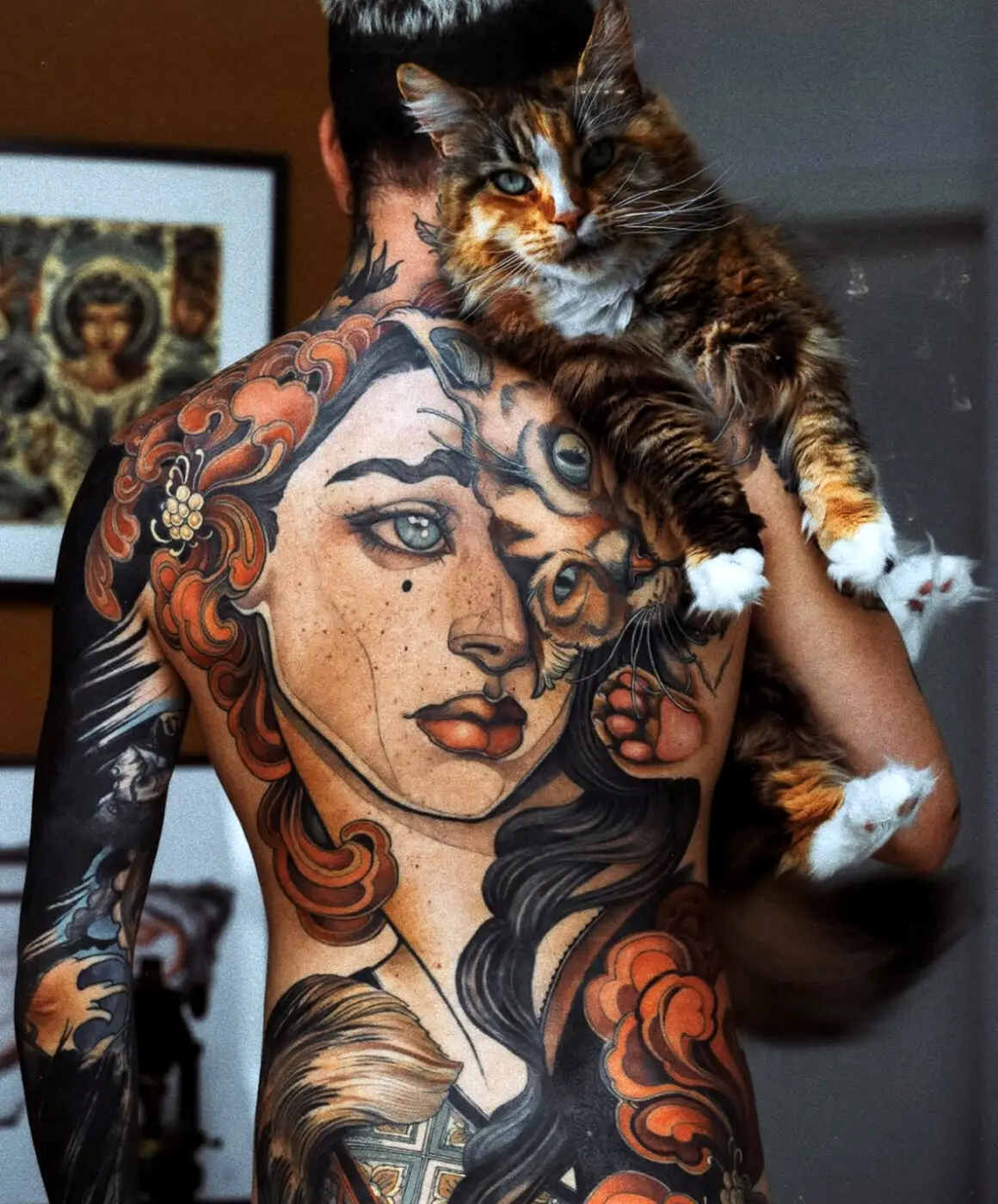
Colour theory becomes central. A neo-traditional piece with a palette of seven or eight tones has to hold together as a composition, and that means the artist needs working knowledge of how colours relate — complement, contrast, temperature, what pairs with what. Traditional work could succeed with a limited palette applied cleanly; neo traditional requires palette selection as a design skill.
Smooth gradient shading is technically demanding. It is built up in multiple passes, often with several needle configurations, and it requires the artist to maintain consistent pressure and depth across a large area. Patchy gradients heal patchy. The time required for a neo-traditional piece is often two to four times that of a comparably sized traditional piece, and the cost reflects this.
The outline work, though less visually dominant, still has to be impeccable. Because the rest of the piece is more detailed and more colour-rich, any failure in the line work sits within a more demanding context and is more easily noticed.
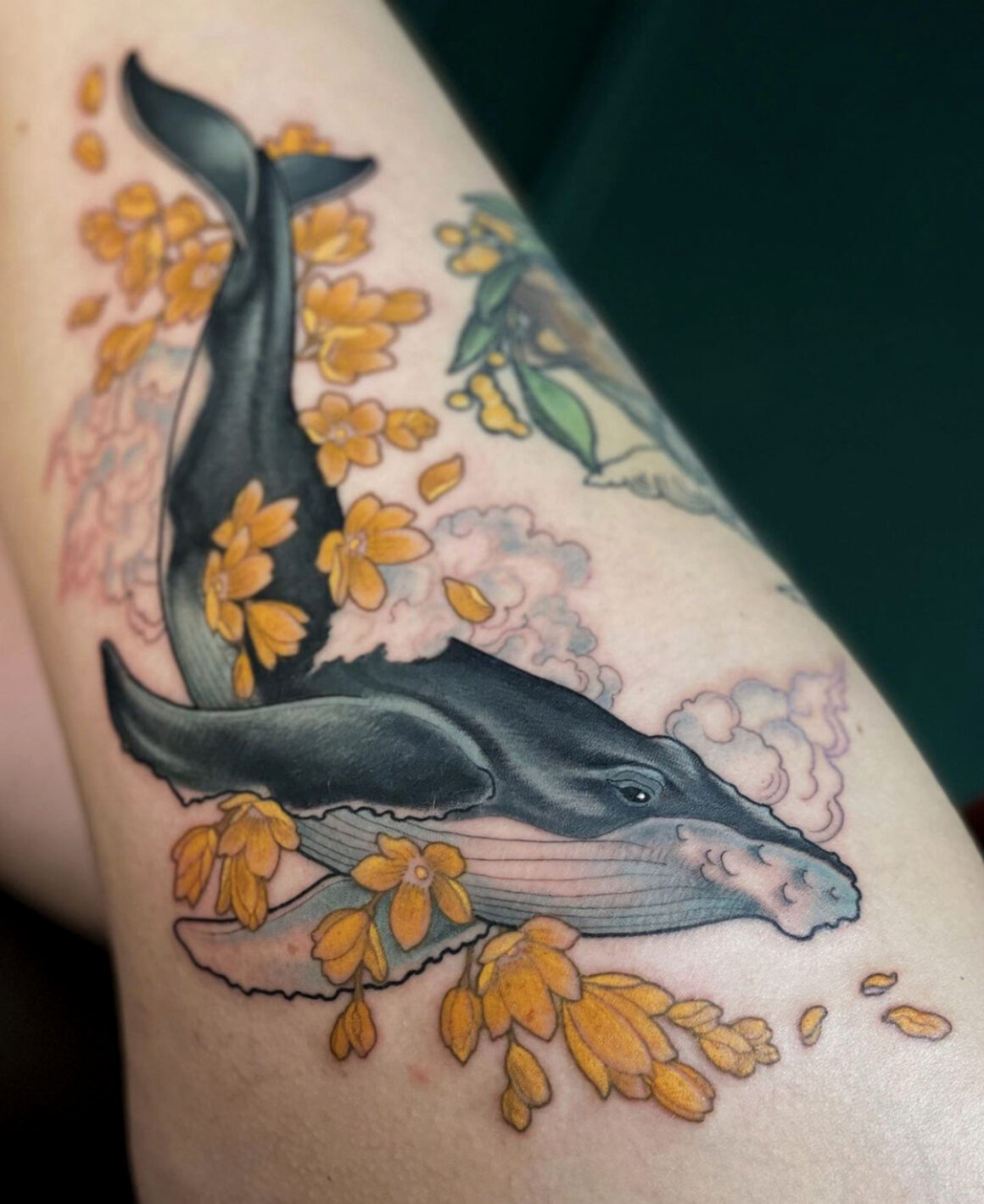
The longevity question is genuinely open. American tradition has proved its ageing behaviour over a century. Neo-traditional, as a coherent style, is perhaps twenty-five years old, and the longest-standing pieces are only now reaching the age where serious ageing becomes visible. The early evidence is mostly good — the heavy outline and the intentional palette both help — but pieces with extensive desaturated-colour fills, very fine internal detail, or heavy reliance on white highlights are already showing the kinds of softening that suggest careful choices matter. A neo-traditional piece done well will probably age better than a photorealistic one and less gracefully than a classic American traditional piece.
What works on skin and what does not
Some practical observations for anyone considering the style.
Scale matters more than in traditional work. Neo-traditional relies on internal detail — fur texture, petal gradation, ornamental framing, small botanical elements — and that detail requires real estate. A neo-traditional fox the size of a playing card will still read after ten years; the same design at the size of a coin will soften into a blob within two or three. Most experienced artists will refuse to do neo-traditional below a certain minimum size, or will simplify the design drastically if forced.
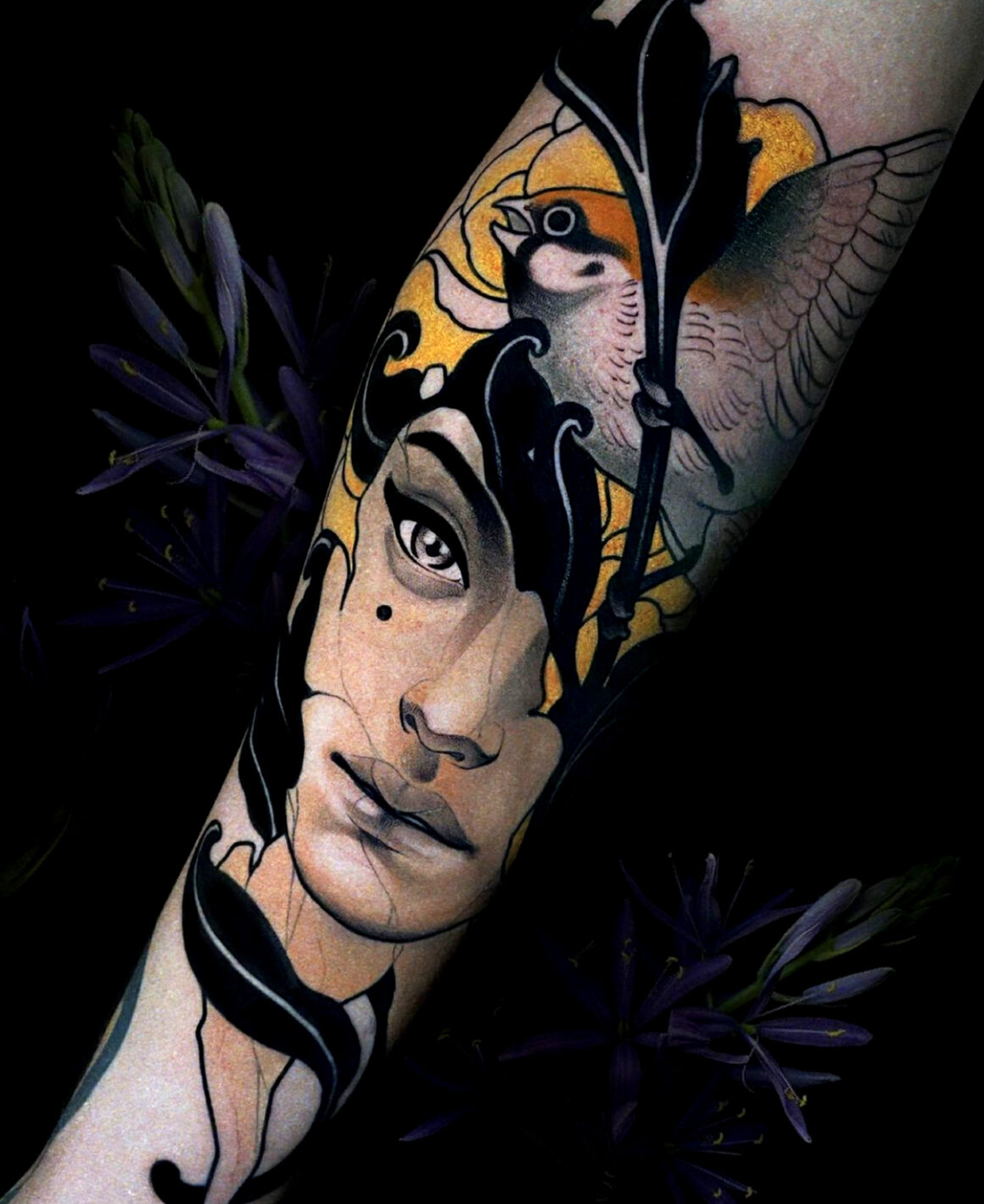
Placement favours large, slow-moving planes. The upper arm, thigh, chest, back, and calf are the strongest locations. The style can be applied to the forearm, but compositional choices become tighter. Below the elbow or knee, on the neck, or on the hands, the combination of detail and friction tends to accelerate softening.
White highlights are a known risk. Neo-traditional often uses small white accents on eyes, metal, and highlight points to lift the image, and white is the first pigment to disappear. Artists who know the style well use white sparingly or replace it with a pale skin-tone tint that holds up better.
Desaturated colours require a competent hand. A well-executed dusty pink or sage green can look extraordinary on skin; the same colour applied too lightly will read as skin after a year. Look at healed photographs — not fresh — before committing to a piece with a muted palette.
Ornamental framing should be committed to fully. Neo-traditional framing elements (leaves, scrollwork, geometric shapes around a central figure) work when they are given weight. Thin, tentative, or sparse framing reads as clutter and weakens the central subject.
Choosing a neo-traditional artist
The style is widely advertised, and the quality range is enormous — a few things to look for.
Check the palette across multiple pieces. A good neo-traditional artist develops a recognisable colour sensibility — certain combinations they return to, a consistent handling of warm versus cool tones. An artist whose portfolio looks like twenty different styles of neo-traditional is usually executing whatever reference the client brings in, rather than working from their own visual language. Both approaches exist, but the first tends to produce more coherent tattoos.
Check the linework on healed pieces, especially in areas where gradient shading sits against the outline. This is the most common failure point. A line that held its weight cleanly against colour fill at six months and stayed clean at two years is evidence of real technical skill.
Check whether the artist draws from the reference properly. Many neo-traditional artists have strong backgrounds in fine art. They will work from a specific reference conversation with the client — a particular bird, a particular plant, a specific composition they want to echo. Artists who work this way tend to produce stronger custom pieces than those who work from a general impression of the client’s description.
Consider the commission timeline. Established neo-traditional artists often book six months to two years in advance. This is an inconvenience but also a filter: an artist who has no waiting list in a high-demand style is worth investigating more carefully.
Where the style sits now
Neo-traditional is in a period of consolidation. The experimental energy of the 2000s and early 2010s has given way to a more established set of conventions, and a recognisable neo-traditional aesthetic now exists within which an artist can work without feeling they are reinventing anything. This has produced a great deal of competent work and some criticism from within the scene that the style has become a formula.
The more interesting current work is coming from artists who use the neo-traditional framework as a starting point and push specific elements further into botanical illustration, folk art, and particular historical periods (medieval illumination, early modern woodcut, Japanese woodblock). These developments are gradually producing subsidiary styles — botanical neo-traditional, folk neo-traditional, and dark neo-traditional with heavier blackwork — that may eventually emerge as recognised categories in their own right.
For a client, the present moment is probably an optimal one to get work done in style. The techniques have matured, the artist base is deep, the pigment technology is good, and enough pieces have aged a decade or two to give a reasonable preview of how the work will hold up. The uncertainty surrounding the style as it was emerging has largely resolved in its favour.
Sources & further reading
- Margo DeMello, Bodies of Inscription: A Cultural History of the Modern Tattoo Community. Duke University Press, 2000.
- Matt Lodder, Painted People: Humanity in 21 Tattoos. Harper, 2024.
- Anna Felicity Friedman, The World Atlas of Tattoo. Yale University Press, 2015.
- Nick Schonberger and Rob Kingston, Forever: The New Tattoo. Gestalten, 2012.
- Robert Ryan and others, Opus. Last Gasp, various years.
- Sarah Mucha. Mucha. Frances Lincoln, 2000.
- Ernst Haeckel, Kunstformen der Natur. 1899–1904.
- Tattoo Artist Magazine. 2007–2015.
- Neo Traditional Tattoos. Cloak & Dagger, London.
- Neo-Traditional Tattoos. Tattoo Life Magazine.