Related Posts

Realism
The bet the style is making
A realism tattoo is a bet against time. Every other major tattoo style is built around the knowledge that skin is a poor archival medium — ink migrates, colour shifts, edges soften, fine detail blurs. Traditional, neo-traditional, Japanese, and new school all work within those limits. Realism does something stranger: it spends enormous technical effort on details that the skin itself will erase over decades. A portrait rendered with the tonal precision of a photograph in 2020 will, in 2050, be a softer and simpler image than it was on the day it was made. Understanding the style means understanding what it is spending that effort to achieve, and what it is willing to give up to achieve it.
Realism is also the style most non-tattooed people think of when they picture a “serious” tattoo today. It is what reality television showcased for most of the 2000s and 2010s, what tattoo-artist Instagram is saturated with, and what the most celebrated artists in the field are often associated with. Understanding what the style is actually doing, where it came from, and what its limitations are — the honest limitations, not the dismissive ones — is worth the effort.
The long history, briefly
The long history, brieflyRealism in tattooing is older than most accounts suggest. Sailors in the nineteenth century commissioned portraits of loved ones as memorial tattoos; prison tattooing in multiple traditions produced recognisable likenesses centuries before the electric machine; Japanese irezumi incorporated detailed figurative rendering within its own stylistic conventions. The idea of putting a recognisable face or a plausibly three-dimensional object on skin is not a late-twentieth-century invention.
What is new is the technical capacity to do it with photographic fidelity. That capacity developed through several specific innovations, each of which shifted what was possible.
The first was the Chicano black-and-grey tradition, which emerged in the California prison system in the 1960s and 70s. Incarcerated tattooers, working with improvised machines and single-ink setups, developed the technique of diluting black ink with water or other carriers to produce graduated tones — the grey wash. The result was a tattoo vocabulary built entirely on tonal gradients rather than outlines and fills. Artists including Freddy Negrete, Jack Rudy, and Charlie Cartwright brought the style out of the prison system and into professional shops in Los Angeles through the 1970s and 80s, particularly at Good Time Charlie’s Tattooland in East Los Angeles. The single-needle technique they refined is the direct ancestor of modern black-and-grey realism.
The second was the gradual shift from coil machines to rotary machines and eventually to cartridge needle systems through the 1990s and 2000s. The newer equipment produced less skin trauma, allowed finer and more consistent needle groupings, and made smooth gradient work easier to execute. Realism at the fidelity currently expected would be technically difficult on 1970s equipment and practically impossible on the equipment of earlier decades.
The third was pigment technology. Modern inks deliver more stable and predictable tones than earlier pigments, and the reliable palette now available includes the subtle skin tones, desaturated colours, and neutral greys that colour realism depends on.
The fourth was cultural: the rise of reality tattoo television in the mid-2000s (Miami Ink, LA Ink, Ink Master) brought realism work to a mass audience, and the artists who became famous through those shows — Kat Von D, Nikko Hurtado, and others — were mostly working in realism or at the realism end of coloured styles. The style became the default showcase of what tattooing could do, which brought both more clients and more artists into the genre.
What realism asks for
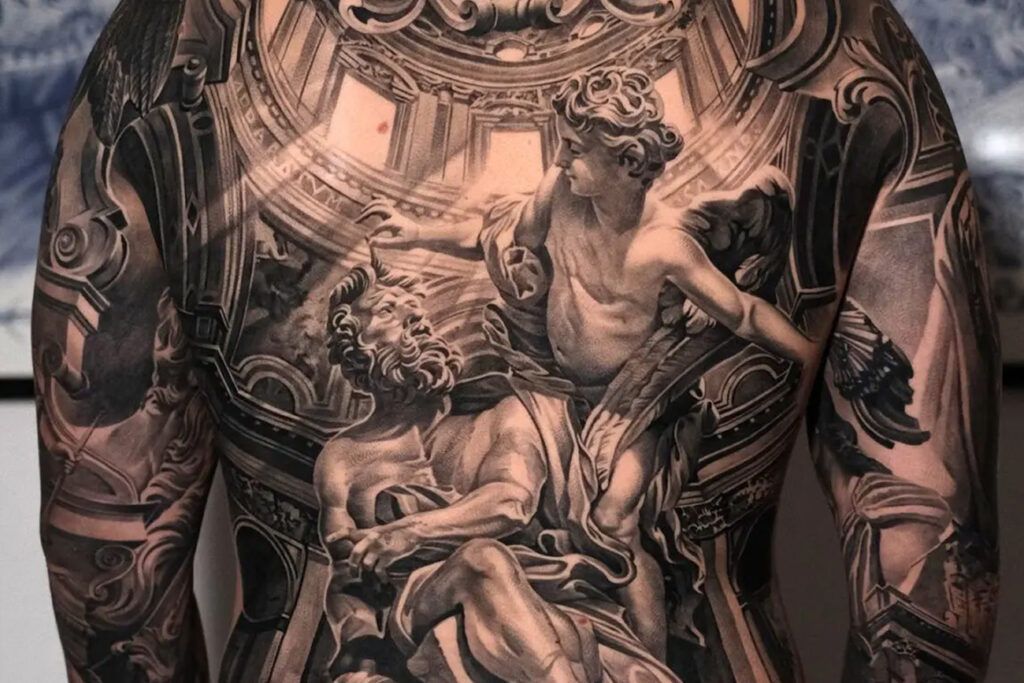
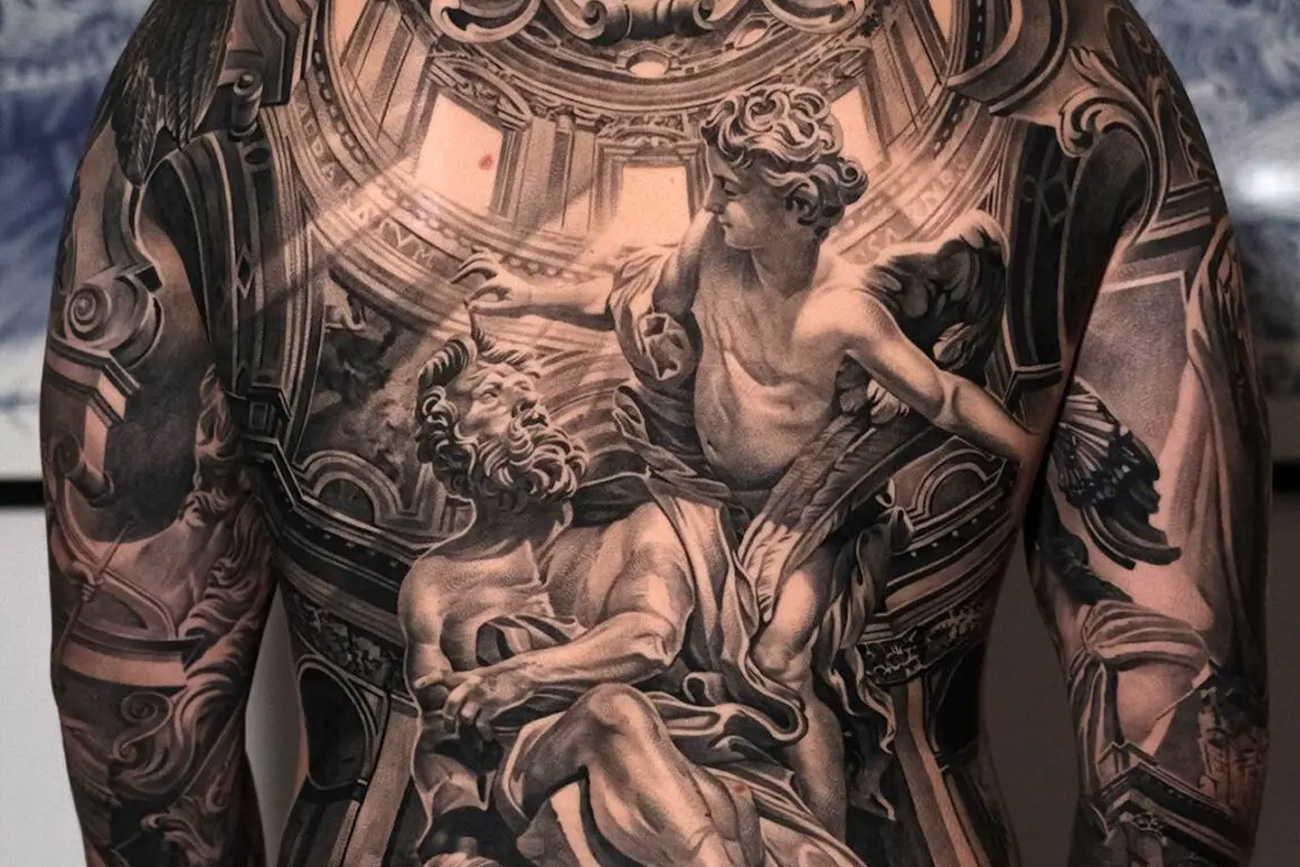
Black-and-grey realism is the direct descendant of the Chicano tradition. It uses diluted black ink to produce a full tonal range from near-white skin tone to deep black, rendering subjects in what amounts to monochrome photography. The branch includes portraiture, religious imagery (the Virgin of Guadalupe, Christ, praying hands — the repertoire shared with Chicano traditional work), photorealistic recreations of landscapes and objects, and much of the single-needle fine-detail work currently popular.
Colour realism adds full chromatic range and is often used for portraits (of people, pets, public figures), wildlife (big cats are a popular subject), and complex compositions involving surfaces that trade on convincing colour — food, flowers, architecture, technology. The demands are higher than black-and-grey because the artist has to manage hue, value, saturation, and skin interaction simultaneously.
Hyperrealism is the term often applied to works that push photographic fidelity to its extreme — pieces that attempt to be visually indistinguishable from the source photograph at normal viewing distance. The term is as much marketing as it is a category, and the line between realism and hyperrealism is not agreed upon within the industry. Most artists who produce hyperreal work identify simply as realism artists.
Micro-realism and single-needle realism use very fine needle configurations to produce small, highly detailed work — usually on the forearm or inside the upper arm, often in black-and-grey, frequently incorporating fine script or linework alongside the detailed rendering. This branch has grown significantly in the 2020s, driven by artists such as Dr. Woo and by younger practitioners working primarily for a social media audience.
Surrealism and composite realism — pieces that apply the technical vocabulary of realism to subjects that do not exist, or to composite images (a clock face melting into a hand, a mountain range inside a human silhouette). The rendering is realistic; the subject is fabricated. This branch includes much of the biomechanical work that Aaron Cain, Guy Aitchison, and others developed from the 1990s onward.
What makes realism technically difficult
Realism is the most technically demanding style in commercial tattooing, and the reasons are worth being specific about, because the difficulty is often described in generic terms that obscure what is actually hard.
Value control is the central skill.
Edge control.
Skin as a medium has its own behaviour.
Scale discipline.
Reference management.
The ageing question
Realism ages less gracefully than any other major tattoo style, and this is the honest assessment regardless of how much the industry sometimes prefers to soften it. The reasons are mechanical.
A realism tattoo is built from thousands of small tonal decisions, each placed with a particular value, edge, and saturation. As the skin settles over years and decades, individual pigment particles migrate outward from their original positions. In a traditional tattoo, this migration produces a slightly softer line inside a still-legible outline, and the piece continues to read correctly. In a realism tattoo, the migration blurs the tonal boundaries that define the image. A convincing photograph of a face in 2020 becomes, in 2040, a face with less defined features; by 2060, it may be a face without enough specificity to identify its subject.
Colour realism has an additional ageing risk: the subtle colour shifts that make a convincing skin tone or flower petal depend on pigment interactions, and those interactions do not age uniformly. Some pigments fade faster than others. The overall colour balance of a piece drifts, usually toward the cooler, muddier end of the spectrum.
Black-and-grey realism ages better than colour realism because there are fewer variables. A black-and-grey piece that softens with age loses some tonal precision but keeps its overall structure as long as the darkest values were committed to strongly. The best Chicano-tradition black-and-grey work from the 1970s still reads clearly today, though in a softer and less photographic register than when it was fresh.
What this means practically: a realism tattoo is often at its best in the first five to ten years. A client choosing the style should understand that they are choosing something that will look its best in its early years and will require honesty about what the piece will become over the decades. Some realism artists recommend periodic touch-ups for clients who want to maintain the sharpness of the work; others prefer to let the piece age and consider the softening part of the tattoo’s life.
What works on skin and what does not
Some practical observations.
Size matters more in realism than in any other style. A portrait smaller than a large adult palm loses information rapidly as it heals and ages. Most serious realism artists refuse to do portraits below a certain minimum size, or refuse specific requests (full-family portraits crowded into a forearm, for example) that cannot be executed with the fidelity the client is imagining.
Placement favours stable, large-radius body planes. The upper arm, outer thigh, calf, chest, and upper back hold realism well. The forearm can work if the piece is designed for it. The ribs, armpit, inner arm, and any highly mobile skin — fingers, the area around joints, the neck — are challenging. Realism on hands, feet, or necks has a significantly accelerated ageing curve compared with placement on stable planes.
Lighting in the reference determines the outcome. A portrait reference shot in even, slightly directional lighting produces a better tattoo than a reference shot in flat ambient light or in harsh noon sun. Clients who arrive with a preferred photograph should expect the artist to suggest adjustments or alternatives, and should treat that guidance seriously.
Subjects with strong tonal structure translate better than subjects without. A face with defined bone structure and clear shadows translates better than a face in flat light. A big cat with a strong mane-and-shadow pattern translates better than a smooth-coated animal shot front-on. This is why certain subjects — eyes, roaring cats, weathered portraits, skulls, classical sculpture — recur in the realism repertoire: they carry themselves well through the medium.
Composition should work against the body, not against the photograph. A realism piece designed as a rectangular print, with sharp boundaries and a flat frame, will fight the body’s curvature and flow. The best realism compositions either fade into the skin at the edges (a portrait with hair dissolving into stippling, a subject rendered against an out-of-focus dark background that bleeds into skin) or accept the body’s shape as part of the composition.
Watch the highlights. Realism depends on white for reflections, eyelight, and the brightest highlights, and white is the first pigment to disappear from a tattoo. An artist who uses white sparingly and intelligently produces work that ages better than one who relies on white for every brightest point.
Choosing a realism artist
The range of quality in realism is enormous. A few things worth looking for.
Look at healed work, not fresh. Fresh realism tattoos look their best in the first hour after application, when the ink is most saturated, and the skin is still reacting. Every realism artist’s fresh portfolio looks impressive. The test is what the work looks like at one year and at five. Any serious artist will have healed images available and will show them willingly.
Check the tonal range in the healed photographs. Does the work still read at a distance? Do the darkest values hold? Have the highlights survived? A piece that healed as a single mid-grey blur is a failure regardless of how impressive the fresh image was.
Understand the artist’s approach to reference. Some realism artists insist on shooting their own reference photographs for portrait work. Others work from client-supplied images but will refuse to work from an image they consider unsuitable. Both are signs of seriousness. An artist who will work from any reference without discussion is less likely to produce durable work.
Booking lead times are long. Top realism artists book six months to several years out. This is an inconvenience, but also a filter — an artist who specialises in realism and has no waiting list is worth investigating more carefully.
Prices are high, and should be. A good realism piece represents many hours of technical work by someone with years of specialised training. Pricing that is significantly below market rate for comparable work is usually a sign that something is missing — either technical quality, experience, or sanitary practices. Saving money on a realism tattoo is a form of false economy.
What the style is good for
Realism is good for what realism can do. It produces better portraits than any other style. It produces more convincing renderings of animals and objects than any other style. For memorial pieces, for recognisable likenesses, for subjects where the photographic quality is the point — a specific dog, a grandparent, a particular view from a particular window — realism is the style that can actually deliver what the client is asking for.
Realism is a poor choice for subjects that do not carry photographic fidelity as part of their meaning. A realist rose will look like a photograph of one specific rose, shot under one specific light. A traditional rose carries the idea of a rose without committing to any single example. The traditional version is more robust, more legible at a distance, and ages better. A graphic style better serves a client who wants the symbol rather than the specimen.
The best realism artists often make this assessment during the consultation. Some subjects ask for realism; others look worse in it than they would in a graphic style. Knowing the difference is part of what separates a specialised realism practitioner from a generalist who offers realism on request.
Realism now
Realism has broadened and diversified considerably since its consolidation as a named style in the 1990s and 2000s. The micro-realism boom of the 2020s has drawn new clients to fine-detail work at small scales. The social media economy has created pressure toward fresh, camera-ready work that photographs well on the day of application, which has sometimes pulled the style away from the longer-term thinking that produced its strongest practitioners. A generation of artists trained primarily through online references rather than direct apprenticeship has produced a wide range of quality, from work that rivals the best of the preceding generation to work that fails quickly on skin.
The strongest current practitioners are usually those with deep drawing backgrounds, rigorous apprenticeships, and a clear-eyed understanding of what skin will and will not hold. In realism, the gap between competent and excellent execution is visible at first glance, and that gap widens over the decades the tattoo must endure on its wearer’s body. A client choosing the style is effectively choosing an artist, and the choice is worth the research it takes to make it well.
Sources & further reading
- Margo DeMello, Bodies of Inscription: A Cultural History of the Modern Tattoo Community. Duke University Press, 2000.
- Anna Felicity Friedman, The World Atlas of Tattoo. Yale University Press, 2015.
- Matt Lodder, Painted People: Humanity in 21 Tattoos. Harper, 2024.
- Nick Schonberger and Rob Kingston, Forever: The New Tattoo. Gestalten, 2012.
- Henry Chalfant and Martha Cooper, Subway Art. Thames & Hudson, 1984; 25th-anniversary edition, 2009.
- Miss Rosen. In photos: the golden age of New York City’s graffiti scene. Huck Magazine, 2023.
- Mário Mateus. New School Tattoos: Creativity & Humour on Steroids. Tattoos Wizard, 2025.